

Lead: Identify Key Stakeholders
Lead is an important step in identifying who are the key stakeholders and champions to implementing suicide prevention best practices at your institution.
- Framework
- Leadership
- Lead Team
- Steering Committee
- Sustainability
- Funding
- Strategic Planning
- Zero Suicide Workforce Survey
Frameworks
Several frameworks offer guidance on strategic planning to design and implement systems of care that are responsive, interconnected and effective at delivering holistic suicide prevention strategies. These resources can provide additional guidance from a systems perspective while also reflecting on an individual, interpersonal, and community level.
The Centers for Disease Control and Prevention Suicide Prevention Resource for Action provides a comprehensive, public health framework that guides suicide prevention efforts across systems and communities. It outlines evidence-based strategies, approaches, and programs that can be tailored to local needs, emphasizing the use of data, multi-sector collaboration, and coordinated interventions that address risk and protective factors at individual, community, and societal levels.
By organizing prevention into seven core strategies, the framework helps healthcare systems and partners implement a structured, upstream-to-downstream approach that not only responds to crisis but also prevents suicide risk before it emerges. The seven core strategies highlighted by the Center are:
- Strengthen Economic Supports
- Create Protective Environments
- Improve Access and Delivery of Suicide Care
- Promote Healthy Connections
- Teach Coping and Problem-Solving Skills
- Identify and Support People at Risk
- Lessen Harms and Prevent Future Risk
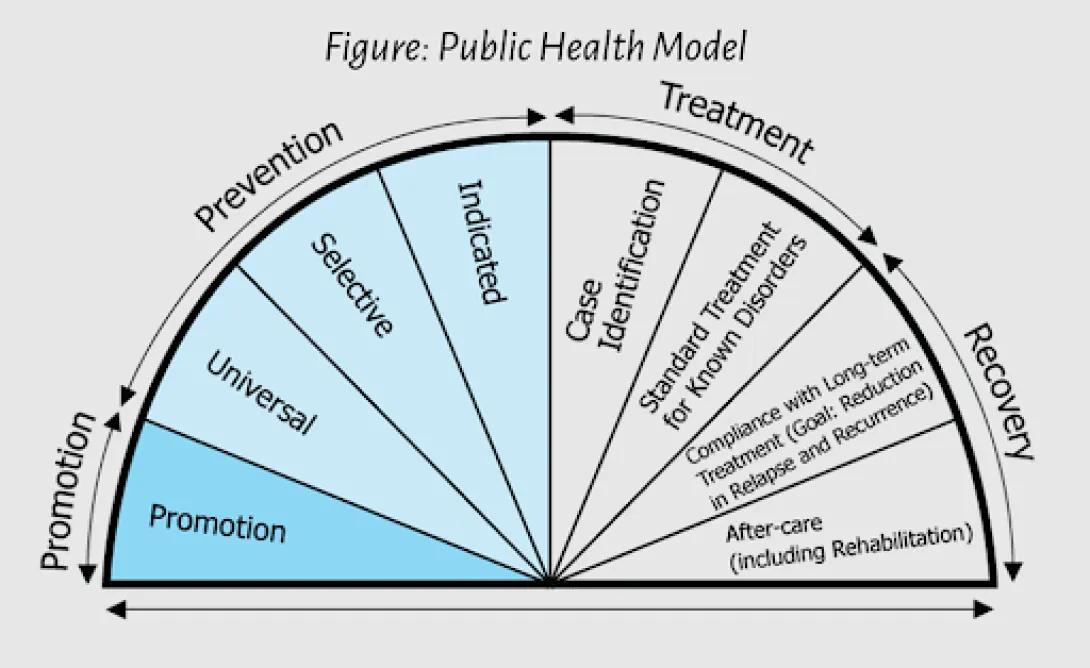
The American Academy of Pediatrics Public Health Framework for Youth Suicide Prevention provides a structured, multi-level approach that can guide comprehensive suicide prevention efforts across systems. It emphasizes addressing suicide risk through universal, selective, and indicated strategies, allowing organizations to implement prevention efforts that range from population-wide education and stigma reduction to targeted interventions and intensive clinical care for high-risk youth.
By integrating prevention, early identification, treatment, and recovery supports as well as emphasizing collaboration across healthcare, schools, families, and communities, the framework serves as an overarching model to align efforts, address risk at multiple levels, and improve outcomes for youth at risk of suicide.
Half circle divided into 8 wedges, labeled from the bottom left to the bottom right: Promotion, Universal, Selective, Indicated, Case Identification, Standard Treatment for Known Disorders, Compliance with Long-Term Treatment (Goal: Reduction in Relapse and Recurrence), After-care (including Rehabilitation).
Along the top edge of the circle are 4 labels above one or more of the wedges. Each label has an arrow at each end of a line below the label.
Label 1: Promotion, is over the Promotion wedge., which is colored turquoise.
Label 2: Prevention, is over the Universal, Selective, and Indicated wedges, which are colored aqua.
Label 3: Treatment, is over the Case Identification and Standard Treatment for Known Disorders wedges, which are colored gray.
Label 4: Recovery is , Compliance with Long-Term Treatment (Goal: Reduction in Relapse and Recurrence), After-care (including Rehabilitation) wedges, which are colored gray.
Leadership
Engaging leadership in this work helps create shared expectations around goals and priorities. Leadership engagement also supports sustainability and ensuring systemic change around suicide prevention work. Zero Suicide emphasizes the importance of this work occurring both at a leadership level as well as on the individual level.
Lead Team
Establishing a dedicated lead team with diverse professional backgrounds is a critical step in developing and guiding a comprehensive suicide prevention strategy within a pediatric healthcare organization. This team should include representatives from clinical care, behavioral health, quality improvement, and administrative leadership to ensure a well-rounded and effective approach. The collective expertise can support identifying current gaps, aligning initiatives with organizational goals, and promoting sustainable change. To maximize impact, lead team members should be formally allocated protected time to focus on suicide prevention efforts, allowing them to engage in planning, training, data review, and implementation activities without competing clinical demands. A well-supported and empowered lead team serves as the foundation for meaningful progress and cultural transformation in suicide prevention.
Steering Committee
Identifying champions and stakeholders in this work from multiple settings can support strategic planning, identifying priorities, and engaging in this work. Steering Committee cadence can be set by the needs of your organization. Representation can include medical, psychiatric, clinical, and non-clinical staff. Additionally, reflecting on faculty vs non-faculty representatives if working in an academic setting. Within both the lead team and steering committee executive leadership experience can ensure suicide prevention is a priority.
Sustainability & Funding
Developing a plan for sustainability and identifying funding opportunities to continue Zero Suicide efforts is essential in leading these efforts. Strategies to promote sustainability will vary organization to organization, but initial steps can include developing committees and leadership structures, engaging in strategic planning and annual priority setting, and developing policies and procedures related to suicide prevention and care. Sustainability includes a focus on devoted time and effort for key staff to engage in suicide prevention practices, while supporting data collection and analysis to inform practice changes and improving outcomes. Your organization can reflect on how to fund initiatives, including incorporating funding as part of operational budgeting, engaging donors who want to support suicide prevention services, and pursuing community resources and grants to partner in advancing these efforts.
Strategic Planning
Once suicide prevention has been identified as a priority engaging in strategic planning can support with identifying priorities and allocating resources. It is important to assess the needs of your organization and the youth and families served as well as leveraging data to inform targeted interventions and monitor outcomes. Key aspects of strategic planning include training providers in early identification of suicidal ideation, implementing standardized screening tools during routine visits, and establishing clear referral pathways to mental health services.
Zero Suicide Workforce Survey
This tool helps assess the current state of practice, identify gaps, and highlight opportunities for growth. Administering the survey early in your initiative can inform strategic planning by surfacing priorities and staff perspectives on confidence and concerns. Repeating the survey over time allows you to track progress and measure system-level changes.
Developing a dissemination plan is essential to gathering relevant data for your zero suicide efforts. Consider your target audience and what data you aim to collect. It’s often useful to segment results by role (clinical vs. non-clinical), setting (inpatient, outpatient, emergency), or specialty (behavioral health, subspecialty, primary care) to better understand the needs and strengths across your system.
Lived Experience
Elevating the voice and providing platforms for youth, families and staff with lived experience is central to the Zero Suicide Framework. These important perspectives provide examples of how individuals have interfaced with systems of care, experienced care in positive and potentially harmful ways, and informs design, implementation, workflows, language use and resource development that infuses this important perspective in suicide prevention service delivery. It is important to integrate lived experience in your leadership framework, working groups, steering committees and have opportunities to engage individuals with lived experience in developing and reviewing suicide prevention services
More Resources
- Livestream Event: Suicide Prevention in Healthcare Settings
- Zero Suicide Healthcare Call to Action
- Leadership: A Critical Component of Workplace Suicide Prevention
- Workplace Suicide Postvention: Utilizing a Plan and Team
- ASPIRES Series: Zero Suicide Model Implementation in Health Systems
- Creating a System of Safety: Advancing Suicide Prevention in Primary Care Settings
- CDCP: PMGR: Zero Suicide through a Public Health Approach
Suicide prevention strategies: An overview of current evidence and best practice elements
Menon V, Subramanian K., Selvakumar N., Kattimani S. International Journal of Advanced Medical and Health Research, (2018).5 (2), 43-51.DOI:10.4103/IJAMR.IJAMR_71_18
Developing the Blueprint for Youth Suicide Prevention.
Gorzkowski HJ, Horowitz LM, Standley CJ, Ryan PC, Wei AX, Lau M., Yu MC. Journal of Public Health Management and Practice, 2023, 29(5), E214–E222. DOI: 10.1097/PHH.0000000000001764
The Consolidated Framework for Implementation Research (CFIR) User Guide: a five-step guide for conducting implementation research using the framework
Reardon CM, Damschroder LJ, Ashcraft LE, Kerins C, Bachrach RL, Nevedal AL, Domlyn AM, Dodge J, Chinman M, Rogal S. Joint Commission Journal on Quality and Patient Safety, 2024, 50(6), 393-403.
- Zero Suicide at EDC Toolkit: Lead
- Suicide Prevention Resource Center: Strategic Planning
- American Academy of Pediatrics: A Public Health Framework for Youth Suicide Prevention
- American Academy of Pediatrics: How to Prepare your Clinic or Health System for a Suicide Prevention Program
APNA Position: Youth Suicide Prevention | American Psychiatric Nurses Association
