Esotropia
Esotropia
What is esotropia?
Esotropia describes an inward turning of the eye and is the most common type of strabismus in infants. Young children with esotropia do not use their eyes together. In most cases, special glasses, bifocals, or early surgery to align the eyes is needed to allow for binocular vision development and to prevent permanent vision loss.
"Accommodative esotropia" is a common form of esotropia that is first seen in farsighted children, usually 1 - 4 years of age or older. When children are young, they can focus their eyes to adjust for farsightedness, a common condition in children. However, the focusing effort (accommodation) required to see clearly stimulates the eyes to converge or cross. “Sensory esotropia” is the crossing of an eye with poor vision.
What causes esotropia?
Esotropia may be seen in children with very poor vision in one eye (sensory esotropia) or in association with certain genetic disorders that affect the eyes. It may also occur in association with a 6th cranial nerve palsy or previous eye muscle surgery for strabismus. But, most often, crossed eyes in childhood are either caused by idiopathic infantile esotropia (33 percent), with onset early within the first 6 - 8 months of life or accommodative esotropia (66 percent) first noted later, between 1 - 4 years of age, in association with increased levels of far-sightedness or hyperopia.
What are the risk factors for esotropia?
Risk factors of esotropia include:
- Positive family history of strabismus (misaligned eyes), amblyopia, childhood cataract, or glaucoma
- Some genetic disorders that affect the eyes
- Pediatric cataracts or glaucoma
- But most often there are no known risk factors in children with esotropia
Appointment Information
To schedule an appointment or for any questions, please call 734-764-7558.
What are the symptoms of esotropia?
Symptoms of esotropia include:
- Decreased vision
- Decreased depth perception
- Crossing or inward deviation of the eyes, often intermittently at first.
The symptoms described above may not necessarily mean that your child has esotropia. However, if you observe one or more of these symptoms, contact your child's ophthalmologist for a complete exam.
How is esotropia diagnosed?
- Visual acuity measurement in each eye and both eyes together (age appropriate)
- Cycloplegic refraction (with dilating eye drops)
- External or slit lamp exam
- Fundus (retina) examination
- Complete eye exam (age appropriate)
How is esotropia treated?
In accommodative esotropia, glasses reduce the focusing effort and convergence of the eyes and can straighten the eyes. Sometimes the addition of bifocals to the glasses is necessary for close work. Eye drops, ointment, or special lenses with prisms added can also be used to straighten the eyes. Eye drops called miotics (phopholine Iodide) or special lenses called prisms can also be used to straighten the eyes in some children depending on the cause and the size of the deviation.
Locations
-
Ophthalmology Clinic | Brighton Center for Specialty Care 7500 Challis Rd
Entrance 1, Level 2
Brighton, MI 48116-9416Get Directions -
Ophthalmology Clinic | Canton Health Center 1051 N Canton Center Rd
Canton, MI 48187-5097Get Directions -
Ophthalmology Clinic | Northville Health Center 39901 Traditions Dr
Floor 2
Northville, MI 48168-9493Get Directions -
Ophthalmology Clinic | River Place Office Building 1974 N Huron River Dr
River Place Offices
Ypsilanti, MI 48197-1654Get Directions -
Pediatric Ophthalmology & Adult Strabismus Clinic | Kellogg Eye Center 1000 Wall St
Floor 1
Ann Arbor, MI 48105-1912Get Directions -
Pediatric Ophthalmology Clinic | Trinity Health Oakland Hospital Medical Office Building
44555 Woodward Avenue, Suite 405
Pontiac, MI 48341Get Directions
Doctors

Steven M Archer, MD
Professor
Ophthalmology

Monte Anthony Del Monte, MD
Professor Emeritus
Ophthalmology
Christopher Gappy, MD
Clinical Assistant Professor
Ophthalmology
Adam Brent Jacobson, MD
Clinical Associate Professor
Ophthalmology
Otana Agape Jakpor, MD, MS
Clinical Assistant Professor
Ophthalmology
Dolly Ann Padovani Claudio, MD
Clinical Instructor
Ophthalmology

Lev Prasov, MD, PhD
Associate Professor
Ophthalmology

Breanna Marie Tracey, MD
Clinical Assistant Professor
Ophthalmology

Grace Meng Wang, MD, PhD
Clinical Assistant Professor
Ophthalmology
Marguerite Cullen Weinert, MD
Clinical Assistant Professor
Ophthalmology
Providers
Courtney Amanda Dewey, OD
Clinical Assistant Professor
Optometry

Carlton J Foster, OD
Clinical Instructor
Optometry
Jacqueline Dinh Hoan My Nguyen, OD
Clinical Assistant Professor
Optometry
News & Stories
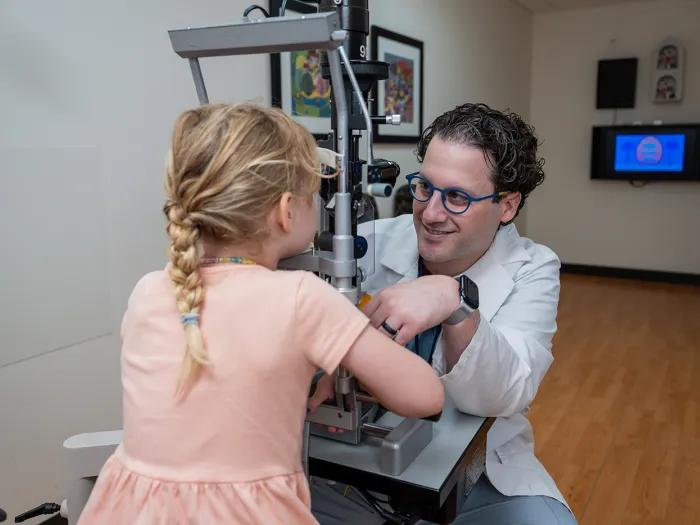
Innovative children’s vision research gets a boost from the Knights Templar Eye Foundation
Nerf gun accident causes retinal detachment in pediatric patient

Kellogg care inspires gift to vision research

Mediterranean diet can slow progression of age-related macular degeneration
Patient with retinitis pigmentosa receives new hope at Kellogg’s low vision clinic