Left Atrial Appendage Occlusion (LAAO)
Left Atrial Appendage Occlusion (LAAO)
What is left atrial appendage occlusion?
Left atrial appendage occlusion uses devices, such as the Watchman FLX Pro and Amplatzer Amulet, to offer select patients with non-valvular atrial fibrillation an alternative to blood-thinning medication to prevent a potentially life-threatening stroke.
Background
More than 5 million Americans have atrial fibrillation (AFib), the most common type of heart arrhythmia. This population is at an increased risk of stroke—in fact, one in three AFib patients is likely to have a stroke. In AFib, the two upper chambers of the heart no longer contract in a coordinated manner, causing the heartbeat to become irregular and blood flow to be slower than normal. This change in blood flow increases the risk of blood clots.
To reduce this risk, AFib patients may need a blood-thinning medication such as warfarin, apixaban, rivaroxaban or other type of anticoagulant. However, some AFib patients may not be able to take blood thinners for various reasons, including a high risk of bleeding, frequent falls or occupational restrictions. For these patients, the Watchman FLX device may be an alternative.
The Frankel Cardiovascular Center at U-M Health is among the first heart centers in the nation to use the original Watchman device to help prevent stroke among patients whose atrial fibrillation is not caused by mitral valve stenosis or surgical mitral regurgitation. Today, the next generation device, the Watchman FLX, is being used by a comprehensive, specially trained U-M Health team to treat a broader range of patients whose anatomy was not suitable with the first generation Watchman device. The Watchman FLX is also safer and enables easier, more efficient closure of the LAA than the first generation device.
The Watchman FLX is designed to treat the widest range of patient anatomies, as shown below:

How does the Watchman FLX Device work?
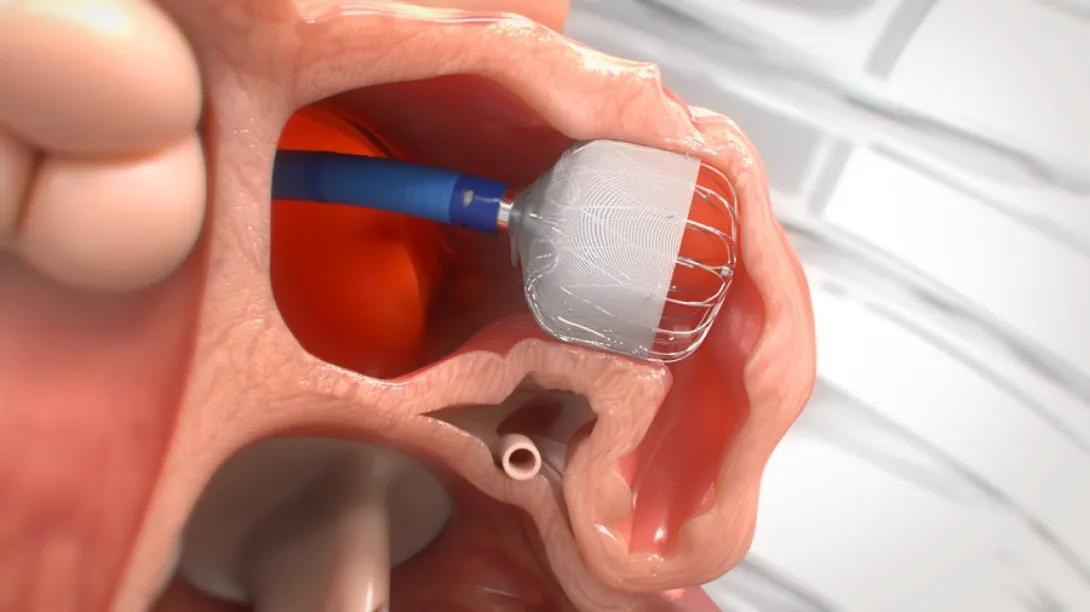
The Watchman FLX device is inserted over a catheter through a recipient’s vein accessed through the groin. It is designed to seal off the heart’s left atrial appendage (LAA), a windsock-like pouch within the upper left chamber. For patients with AFib, over 95% of stroke-causing clots are formed in the LAA. A person’s heart tissue will grow over the permanent implant in time.
The Watchman FLX Device is implanted using an access sheath inserted through the femoral vein:
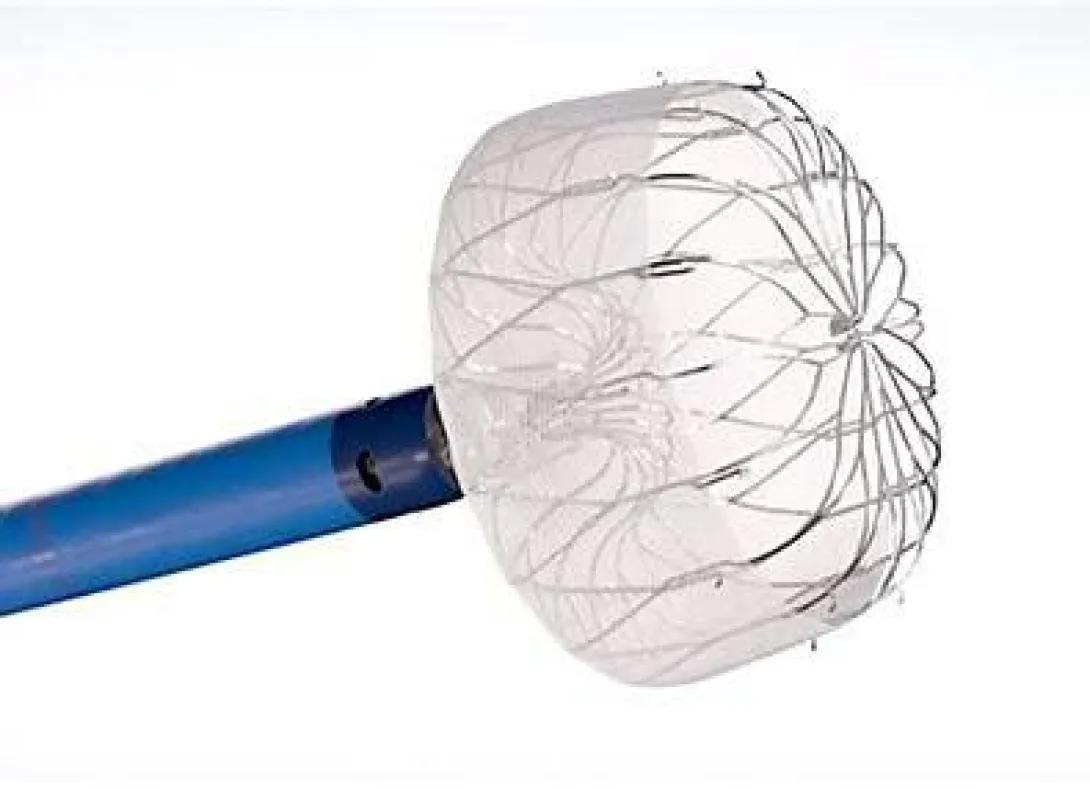
The Watchman FLX Device closes off the heart’s Left Atrial Appendage where blood clots tend to form:
Who is eligible for the device?
The Watchman FLX isn’t meant to be a universal alternative to anticoagulants, with only carefully chosen patients eligible for it.
The Watchman FLX is for patients who:
- Have been recommended to take blood thinning medicines by their doctor
- Are at increased risk for stroke and are recommended for anticoagulation therapy
What to Expect
A potential recipient will undergo a transesophageal echocardiogram (TEE) or CT scan to ensure no existing clots are present and to determine whether the appendage is compatible with one of the available device sizes and shapes. Clots, if detected, will need to be treated with blood thinners before proceeding.
Approximately the size of a quarter, the Watchman FLX device is implanted like a stent using a narrow tube (catheter) inserted through a small incision in the right groin and guided into the heart while the patient is under general anesthesia. The minimally invasive procedure typically takes no more than 1-2 hours and involves only an overnight hospital stay. Patients should be able to return to normal activities shortly after the procedure.
Extended follow-up is provided. A recipient can expect subsequent TEEs at 45 days and 12 months after surgery to ensure that the Watchman FLX is working properly and the left atrial appendage remains closed.
According to Boston Scientific (makers of the device) the Watchman FLX has a proven record of safety and success, with 98.8% of patients successfully implanted with the device.
Appointment Information
To schedule an evaluation with a Frankel Cardiovascular Center physician, call 888-287-1082 or visit the Make a Cardiovascular Appointment page.
Locations
-
Electrophysiology Services | Cardiovascular Center 1425 E Ann St
Floor 3 Reception C
Ann Arbor, MI 48109-5856Get Directions
Doctors

Kelly Arps, MD
Clinical Assistant Professor
Cardiac Electrophysiology, Internal Medicine, Cardiovascular Disease

Apurba Kent Chakrabarti, MD
Clinical Assistant Professor
Cardiovascular Disease, Internal Medicine

Thomas Christopher Crawford, MD
Clinical Professor
Cardiac Electrophysiology, Internal Medicine, Cardiovascular Disease

Amrish Deshmukh, MD
Clinical Assistant Professor
Cardiac Electrophysiology, Cardiovascular Disease, Internal Medicine
Hamid Ghanbari, MD
Clinical Associate Professor
Cardiac Electrophysiology, Internal Medicine, Cardiovascular Disease
Michael Ghannam, MD
Clinical Associate Professor
Cardiac Electrophysiology, Internal Medicine, Cardiovascular Disease

Emma Hegwood, DO
Clinical Assistant Professor
Cardiac Electrophysiology, Cardiovascular Disease, Internal Medicine

Krit Jongnarangsin, MD
Clinical Professor
Cardiac Electrophysiology, Internal Medicine, Cardiovascular Disease

Rakesh Latchamsetty, MD
Clinical Professor
Cardiac Electrophysiology, Internal Medicine, Cardiovascular Disease
Jackson Jeikai Liang, DO
Clinical Associate Professor
Cardiac Electrophysiology, Internal Medicine, Cardiovascular Disease

News & Stories

Young father survives aortic dissection after delayed diagnosis
C.S. Mott Children’s Hospital first in country to implant expandable heart valve during FDA review phase
How a temporary heart pump can support high risk cardiac surgery

Treating a rare coronary artery aneurysm without open heart surgery

Fontan patient inspires as pediatric cardiology fellow