
Aortic Disease Overview
Aortic Disease Overview
What is aortic disease?
Aortic disease refers to a group of conditions that affect the aorta and the aortic valve.
Explore all Aortic Disease services
About the Aorta
The aorta is the body’s main artery. It carries oxygenated blood from your heart to your head, vital organs, arms and legs.
Shaped like a cane, the aorta begins at the heart and includes several sections:
- Aortic root: This is the first part of the aorta and serves as the connection between the heart and the aorta. The aortic root houses the aortic valve.
- Ascending aorta: This is the main trunk of the aorta. From the root, this section of the aorta travels up toward your head.
- Aortic arch: The aorta makes a half turn towards the back. This curve is called the aortic arch and contains branching arteries that branch out and carry blood to your head and arms.
- Descending aorta: This part of the aorta runs through your back next to the spine and abdomen (stomach area).
About the Aortic Valve
The aortic valve is one of four heart valves. It is located between the lower left heart chamber (left ventricle) and the aortic root. It has three flaps called leaflets that open and close when the heart beats. The aortic valve prevents blood from flowing backward into the left ventricle.
Anatomy of the Aorta
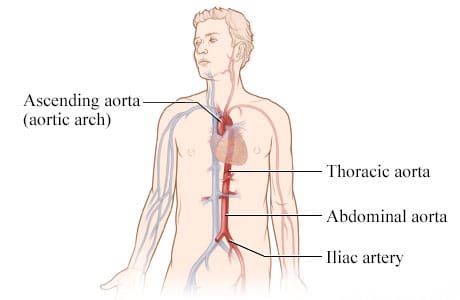
The aorta stems from the heart, arches upward (the aortic arch), and then extends down behind the heart and through the chest (the thoracic aorta) and the abdomen areas (the abdominal aorta). The aorta then branches out and becomes the iliac arteries, which provide blood to the pelvis and legs.
Our Approach
The U-M Health Frankel Cardiovascular Center is nationally ranked for cardiology and heart surgery by U.S. News & World Report. This ranking reflects our exceptional team-based approach to care across multiple specialties
As the go-to program in the state for complex aortic disease, our Comprehensive Aortic Program has unmatched expertise in all types of aortic conditions. Many patients come to us for procedures that are not available elsewhere. Others choose us because they want to receive care at one of the top institutions in the country.
Appointment Information
To schedule an evaluation with a Frankel Cardiovascular Center physician, call 888-287-1082. Or visit the Make a Cardiovascular Appointment page to learn what to expect when you call us.
Physicians: To refer a patient, call M-Line at 800-962-3555.
What are the most common types of aortic conditions?
The most common types of aortic conditions are aneurysms and dissections, in which the aortic wall bulges (aneurysm) or tears (dissection).
Conditions that affect the aortic valve include regurgitation (the valve leaks) and stenosis (the valve becomes narrow). An aneurysm or dissection that occurs near the heart can also damage the aortic valve.
An aortic aneurysm is a bulge in a weakened area of the wall of the aorta. Aneurysms can occur anywhere along the aorta and are classified by their location:
- Thoracic aneurysms occur in the chest and can involve the aortic root, ascending aorta, aortic arch and the upper part of the descending aorta.
- Abdominal aneurysms occur in the part of the descending aorta located in the abdomen.
- Thoracoabdominal aneurysms occur in the area from the chest to the abdomen.
Over time, aneurysms can burst and cause life-threatening internal bleeding.
The wall of the aorta has three layers. An aortic dissection occurs when the inner layer of the wall tears and leaking blood causes the inner and middle layers to separate.
Aortic dissections are classified as type A or type B:
- Type A dissections occur in the ascending aorta.
- Type B dissections occur in the descending aorta.
The buildup of pressure can cause the outer layer of the aorta to burst, creating a life-threatening condition that requires emergency repair.
Aortic valve diseases include regurgitation and stenosis:
- Aortic regurgitation occurs when the aortic valve doesn’t close all the way. This allows blood to leak back into the left ventricle. It’s also called a leaky valve.
- Aortic stenosis occurs when the valve hardens and narrows. The heart has to work harder to pump blood into the aorta.
In general, leaking valves can be repaired, while stenotic valves must be replaced.
An aneurysm or dissection that occurs near the aortic root may damage the aortic valve. In this case, our aortic surgeons use advanced techniques to repair or replace the valve.
What are the genetic causes of aortic disease?
Some aortic conditions are caused by genetic changes that weaken the aortic wall and increase the risk of aneurysms and dissections. These conditions are classified as either syndromic aortic diseases and nonsyndromic aortic diseases.
The Frankel Cardiovascular Center is a leading research institute for the genetic causes of aortic diseases. Our groundbreaking work seeks new therapies to prevent aneurysms and dissections from occurring in these patients.
A syndrome is a group of clinical symptoms that occur together. Aortic aneurysms and dissections are associated with several syndromic connective tissue disorders, including:
- Marfan syndrome
- Ehlers-Danlos syndrome
- Loeys-Dietz syndrome
People with these syndromes have problems with their connective tissues, which link and provide support to the structures of the body.
Some thoracic aortic aneurysms and aortic dissections have a genetic cause but are not associated with a syndrome. These conditions usually run in families and are caused by a mutation to a single gene, such as ACTA2, PRKG1 or MYH11.
How is aortic disease treated?
Our aortic specialists offer a wide range of procedures to treat aortic conditions, including:
- Minimally invasive procedures that use catheters, or small tubes, to replace or repair damaged valves or sections of the aorta
- Open surgery, which may yield better outcomes under certain circumstances. Our surgeons are leaders in developing and performing complex open surgical procedures.
- Hybrid approaches, which combine minimally invasive and open surgical procedures.
We work with you to develop an individualized treatment plan that meets your needs.
