Minimally Invasive Heart Surgery Treatment
Minimally Invasive Heart Surgery Treatment
What is minimally invasive heart surgery?
Minimally invasive heart surgery allows a surgeon to access the heart through less intrusive methods than traditional open-heart surgery which requires a surgeon to make a large incision through the breastbone to access the heart. Minimally invasive surgery often utilizes robotic or endoscopic assistance to perform.
Our Approach
The U-M Health Frankel Cardiovascular Center is nationally ranked for cardiology and heart surgery by U.S. News & World Report. This ranking reflects our exceptional cardiovascular surgeons and surgical teams.
Our team at the Frankel Cardiovascular Center offers a range of minimally invasive treatment options. Many patients come to us for procedures that are not available elsewhere. Others choose us because they want to receive care by expert surgeons and teams at one of the top institutions in the country.
What types of minimally invasive heart surgery are there?
Thoracotomy - A small incision between the ribs is called a thoracotomy. A narrow hi-definition camera, called a thoracoscope, is inserted through a tiny incision and is used to aid the surgeon’s view of the heart and valve. The surgeon is then able to use a long, thin instrument to perform the operation.
Robotic-assisted heart surgery - Minimally invasive heart surgery can also be performed with the assistance of a robot. In this case, the procedure is similarly performed through small incisions between the ribs. However, instead of placing a thoracoscope, the robotic arms are guided through the small incisions and include a camera to view the heart. The surgeon then controls the robotic arms to operate.
Transcatheter-based procedures - Another form of minimally invasive heart surgery/intervention is performed using a catheter, or small tubes placed often through the groin vessels. Transcatheter-based approaches are performed in the hybrid operating room with a team of doctors.
Appointment Information
To schedule a procedure or request a second opinion with a Frankel Cardiovascular Center physician, call 888-287-1082 or visit the Make a Cardiovascular Appointment page to learn what to expect when you call us.
Physicians: To refer a patient, call M-LINE at 800-962-3555.
What treatments are minimally invasive heart surgeries used for?
A variety of heart surgeries can now be performed using minimally invasive techniques, including:
- Atrial septal defect (ASD) repair/closure
- Coronary artery bypass grafting (CABG)
- Endoscopic mitral valve repair/ replacement
- Endoscopic tricuspid valve repair/ replacement
- Maze procedure for atrial fibrillation
- Patent foramen ovale (PFO) repair/closure
- Robotic-assisted minimally invasive direct coronary artery bypass (RA-MIDCAB)
- Transcatheter aortic valve replacement (TAVR)
- Transcatheter mitral valve repair (TMVr)
- Transcatheter tricuspid valve replacement (TTVR)
- Valve-in-valve TAVR
- Ventricular assist device (VADs) placement
What are the benefits of minimally invasive heart surgery?
Because minimally invasive surgeries do not require large incisions or breaking the sternum, they are associated with many benefits, some of which include:
Shorter time in the hospital
Faster recovery time
Less risk of infection
Minimal scarring due to smaller incisions
Less blood loss and need for transfusions
Lower risk of stroke
Less pain
Minimally invasive heart surgeries are safe and effective. Though, as with any procedure, there are risks of complications involved. That risk is, however, lower with a minimally invasive surgery compared to open-heart surgeries.
News & Stories
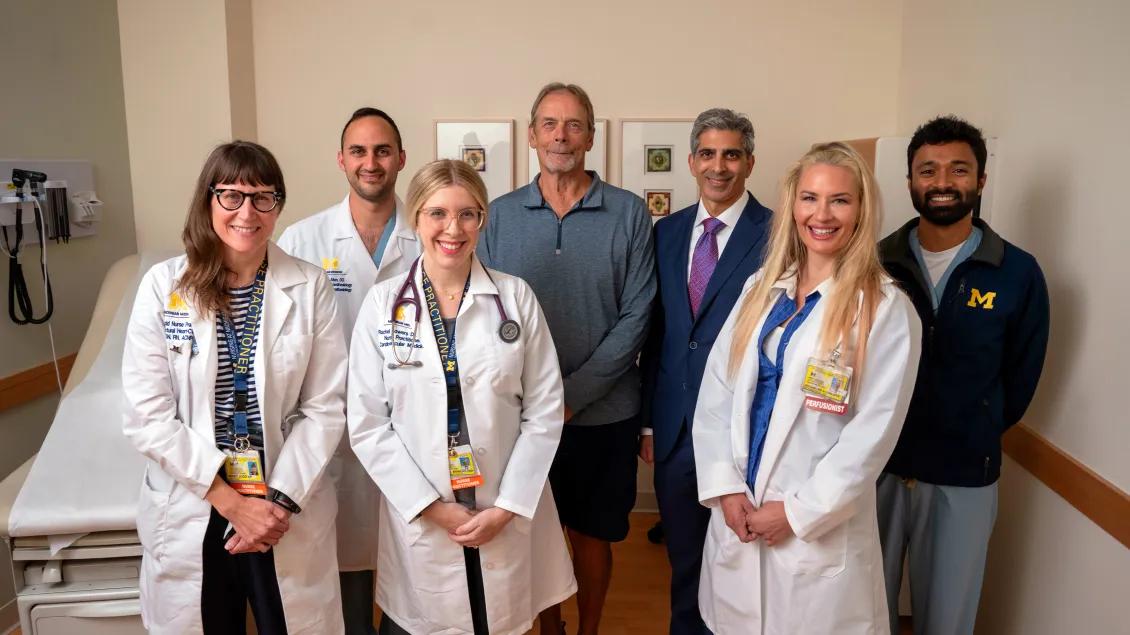
Planting a tree, and hope, for a heart healthy future

Young father survives aortic dissection after delayed diagnosis

C.S. Mott Children’s Hospital first in country to implant expandable heart valve during FDA review phase
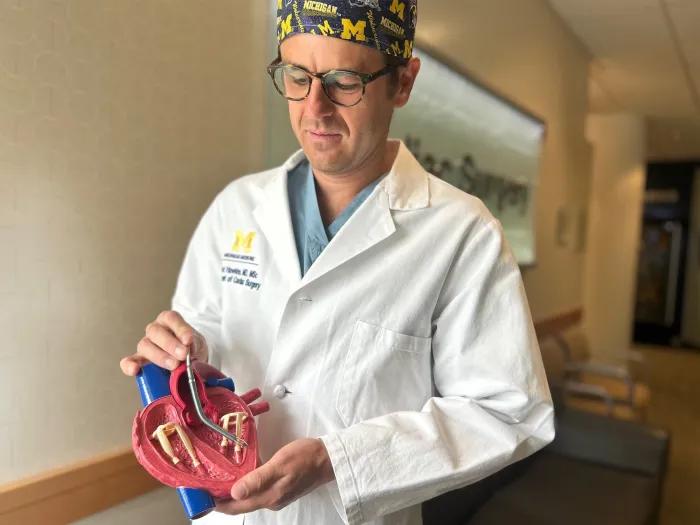
How a temporary heart pump can support high risk cardiac surgery