Kidney Transplant (Pediatric)
Kidney Transplant (Pediatric)
What is a kidney transplant?
Diseased kidneys do not do a good job of filtering toxins or removing water from the body. To stay healthy, children with diseased kidneys will need dialysis or a kidney transplant. A kidney transplant improves the length and quality of life of children whose own kidneys have failed.
Kidney transplant is the therapy of choice for children with kidney failure, but there are other options, such as hemodialysis and peritoneal dialysis. Our medical team can help you determine which one is best for your child and your family.
Our Approach
At the University of Michigan Health, we have performed more than 635 kidney transplants since the program's beginning in 1964, and we can report organ rejection and patient survival rates that rank among the world's best. We have the most experienced program in the state, with particular expertise in the transplantation of children under the age of 2.
Because of our high volume, decades of experience, cutting-edge therapies and multidisciplinary team of specialists, we can perform transplants for children who have been turned down by other centers, including those with surgical issues, children who are obese, and children who are sensitized.
Family-centered care
Our team provides personalized care with a dedicated group of specialists, including social workers, dietitians, nephrologists, surgeons, and more, ensuring families are fully involved in their child’s treatment. We offer education and support at every stage—before, during, and after transplant—through Child Life services and Pediatric Transplant Psychologists to reduce anxiety and empower kids in their care.
With access to advanced treatments like desensitization for incompatible donors and clinical trials not widely available, we specialize in complex cases, including infants and children with cardiovascular or urological challenges. Our strong nutrition program helps prepare kids for earlier transplants, and our team performs several pediatric kidney transplants each year.
Appointment Information
For more information, contact us at 734-615-2040.
What To Expect
Candidates for kidney transplant require a comprehensive evaluation. The process includes education, medical records review, patient examination and often additional medical testing. The cases are then reviewed by our transplant team and a decision about each child’s suitability for an organ is made.
Routine medical care must be current prior to transplantation. It’s recommended that children are current with their routine health care prior to their evaluations including dental exams and immunizations (including PPD, pneumovax, and influenza vaccine).
At the evaluation appointment, the child and family meets with several members of the pediatric transplant team, including a transplant coordinator, nephrologists, surgeon, social worker and transplant nurse. The evaluation appointment often involves blood work, a chest x-ray, and an ECHO. This appointment takes about 4 hours. Some patients will require additional testing and follow-up appointments.
When a donor organ becomes available, the child and family head to the hospital. The vast majority of the time, the child’s kidney is not removed simply because it’s not necessary. The new kidney is placed in the lower abdomen or pelvis. Following the operation, the child goes to the PICU (pediatric intensive care unit) for initial management and then to the hospital room. Children may be discharged between 5 and 10 days after the procedures, depending on their age and how smoothly they recover from the operation.
Children are seen weekly for the first three months following transplant. The transplant team will be communicating throughout the process with the child’s referring nephrologist and primary care provider. Eventually, follow-up clinic visits will be scheduled every three or four months at University Hospital.
After the transplant
Our team is dedicated to helping children become healthy, productive adults. To ensure they are able to care for themselves as they get older and go on to live independent lives, we assess each child carefully to determine their ability for self-care. We begin that transition process very early – before they are teenagers – so they learn to administer their own medications, call for their own prescriptions schedule testing and more. It takes a lot of supervised transition education before most kids can provide their own self-care. The earlier we start the process, the better their chances for success.
- Children can typically return to school 6-8 weeks after transplantation.
- A dedicated social worker will help families arrange home schooling until they can go back to school full time.
- For those who participate in sports, we will provide a referral for a specialized shield to wear for protection It is molded for each child and worn discretely under the uniform.
- Our Transplant Specialty Pharmacy has pharmacists and customer service staff specialized in transplant medications; dedicated solely to assisting our patients through their treatment process.
- Each summer we provide children 8-15 years of age who have had an organ transplant an exciting camping experience called Camp Michitanki.
View Kidney information in the U-M Health Patient Education Library
Living Donor Program
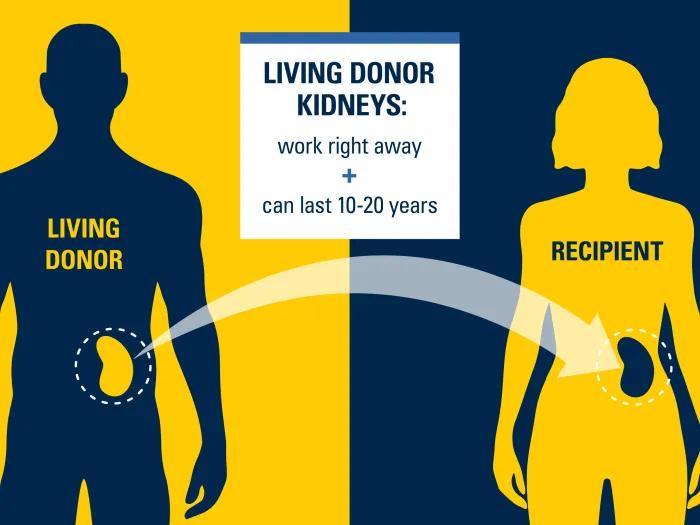
Due to the number of people on the kidney waiting list and the short supply of deceased donor organs, the waiting period for a deceased donor kidney can be several years. Therefore, if you are waiting for a kidney, having a live donor will significantly decrease your waiting time for a kidney transplant.
Patient Resources
Research
Research is an important component of the U-M Health Transplant Center, where we are committed to cutting-edge studies that will benefit today's children and patients of the future. As the site of the Kidney Epidemiology and Cost Center, and as an integral component of the Scientific Registry of Transplant Recipients, our team annually collects and analyzes data on dialysis patients worldwide, and on all transplant recipients in the U.S. This makes us the world's leader in dialysis and transplant outcome research. Furthermore, comprehensive multi-disciplinary clinics and extensive clinical and basic science research program assure our patients access to the newest medications and technologies.
Locations
-
Pediatric Transplant Clinic | C. S. Mott Children's Hospital 1540 E Hospital Dr
Floor 8 Reception B
Ann Arbor, MI 48109-4259Get Directions
Doctors

Meredith Barrett, MD
Clinical Associate Professor
Surgery

Ben Edwin Biesterveld, MD
Clinical Assistant Professor
Transplant Surgery, Surgery
Mary Hauswirth Borst, MD
Clinical Instructor
Pediatric Nephrology, Pediatrics

Michael Joseph Englesbe, MD
Professor
Surgery

Danielle Haakinson, MD
Clinical Instructor
Surgery

David Berrey Kershaw, MD
Professor
Pediatric Nephrology, Pediatrics

Clare Joan Lindner, MD
Clinical Assistant Professor
Pediatric Nephrology, Pediatrics

Rebecca Mary Lombel, MD
Clinical Assistant Professor
Pediatric Nephrology, Pediatrics

Kera Elizabeth Luckritz, DO
Clinical Associate Professor
Pediatric Nephrology, Pediatrics

John C Magee, MD
Professor
Surgery, Transplant Surgery








Providers

Melissa Kaye Cousino Hood, PhD
Clinical Professor
Clinical Child & Adolescent Psychology, Clinical Psychology

Emily MacDonald Fredericks, PhD
Clinical Professor
Clinical Child & Adolescent Psychology, Clinical Psychology
News & Stories

Continuing the legacy of a doctor’s doctor

A pediatric epilepsy fundraiser that changes lives

Block Out Cancer: From a crisis abroad to answers at Mott
Research may help better predict outcomes in kids with congenital cytomegalovirus

Kidney transplant recipient celebrates 10 year anniversary at Transplant Games