Astigmatism
Astigmatism
What is astigmatism?
Astigmatism usually occurs when the front surface of your eye, the cornea, has an irregular curvature. Astigmatism is one of a group of eye conditions known as refractive errors and these errors cause a disturbance in the way that light rays are focused within your eye. Astigmatism often occurs with nearsightedness and farsightedness, conditions also resulting from refractive errors. Astigmatism is not a disease nor does it mean that you have "bad eyes." It simply means that you have a variation or disturbance in the shape of your cornea.
Appointment Information
For more information or to make an appointment, call 734-764-4190.
What are the symptoms of astigmatism?
- Distortion or blurring of images at all distances
- Headache and fatigue
- Squinting and eye discomfort or irritation
The symptoms described above may not necessarily mean that you have astigmatism. However, if you experience one or more of these symptoms, contact your ophthalmologist for a complete exam.
What are the causes of astigmatism?
Normally, the cornea is smooth and equally curved in all directions and light entering the cornea is focused equally on all planes or in all directions. In astigmatism, the front surface of the cornea is curved more in one direction than in the other. This abnormality may result in vision that is much like looking into a distorted, wavy mirror. The distortion results because of an inability of the eye to focus light rays to a single point.
If the corneal surface has a high degree of variation in its curvature, light refraction may be impaired to the degree that corrective lenses are needed to help focus light rays better. At any time, only a small proportion of the rays are focused and the remainder are not, so that the image formed is always blurred. Usually, astigmatism causes blurred vision at all distances.
What are the risk factors for astigmatism?
A small amount of astigmatism is very common and the tendency to develop astigmatism is inherited. A larger amount of astigmatism can be associated with diseases such as keratoconus.
How is astigmatism diagnosed?
The amount of astigmatism in the eye can be measured in various ways. The autorefraction or the subjective refraction—based on the patient’s response—that are done at the beginning of an eye exam is one way to measure astigmatism. The amount of astigmatism caused by the cornea is measured in the clinic by a diagnostic instrument called a keratometer.
How is astigmatism treated?
If the degree of astigmatism is slight and there are no other problems of refraction, such as nearsightedness or farsightedness, corrective lenses may not be needed. If the degree of astigmatism is great enough to cause eye strain, headache, or distortion of vision, corrective lenses will be needed for clear and comfortable vision.
Your ophthalmologist will perform precise tests during your exam to determine the ideal lens prescription. Refractive surgery also may be an option for correcting some forms of astigmatism.
Astigmatism may increase slowly. Regular eye care can help to insure that proper vision is maintained. You may have to adjust to wearing eyeglasses or contact lenses if you do not wear them now. Other than that, astigmatism probably will not significantly affect your lifestyle.
Locations
-
Comprehensive Ophthalmology & Cataract Surgery Clinic | Kellogg Eye Center 1000 Wall St
Floor 1
Ann Arbor, MI 48105-1912Get Directions -
Ophthalmology Clinic | Brighton Center for Specialty Care 7500 Challis Rd
Entrance 1, Level 2
Brighton, MI 48116-9416Get Directions -
Ophthalmology Clinic | Canton Health Center 1051 N Canton Center Rd
Canton, MI 48187-5097Get Directions -
Ophthalmology Clinic | Chelsea Health Center 14700 E Old US Highway 12
Floor 1
Chelsea, MI 48118-1185Get Directions -
Ophthalmology Clinic | Northville Health Center 39901 Traditions Dr
Floor 2
Northville, MI 48168-9493Get Directions -
Ophthalmology Clinic | West Ann Arbor Health Center-Parkland Plaza 380 Parkland Plaza Ste 210
Floor 2
Ann Arbor, MI 48103-6201Get Directions
Doctors

Jill Elizabeth Bixler, MD
Clinical Assistant Professor
Ophthalmology

Theresa M Cooney, MD
Clinical Associate Professor
Ophthalmology

Julia Dalia, MD
Clinical Assistant Professor
Ophthalmology

Joshua Robert Ehrlich, MD, MPH
Associate Professor
Ophthalmology

Angela Renee Elam, MD, MPH
Assistant Professor
Ophthalmology, Oculoplastics Ophthalmology
Charles Ross Frank, MD
Clinical Assistant Professor
Ophthalmology

Sarah Jayne Garnai, MD
Clinical Assistant Professor
Ophthalmology
Sean Owen Hansen, MD
Clinical Assistant Professor
Ophthalmology

Vanitha Isaac Jeyaraj, MD
Clinical Assistant Professor
Ophthalmology

Ariane Dev Kaplan, MD
Clinical Associate Professor
Ophthalmology











News & Stories
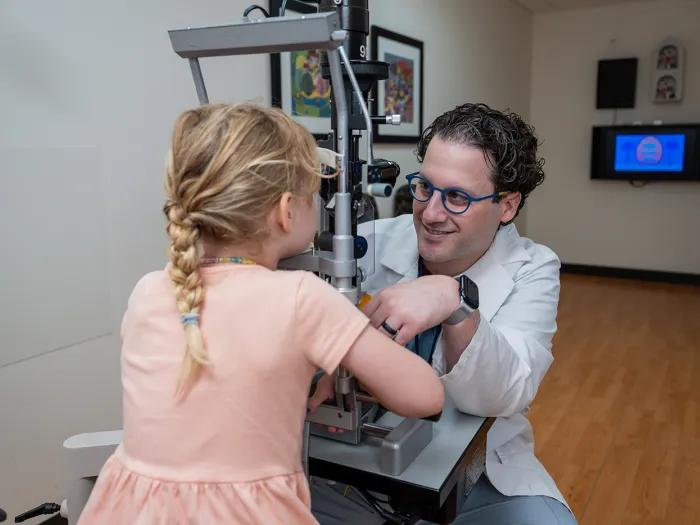
Innovative children’s vision research gets a boost from the Knights Templar Eye Foundation

Nerf gun accident causes retinal detachment in pediatric patient

Kellogg care inspires gift to vision research

Mediterranean diet can slow progression of age-related macular degeneration

Patient with retinitis pigmentosa receives new hope at Kellogg’s low vision clinic