Enhanced External Counter Pulsation (EECP)
Enhanced External Counter Pulsation (EECP)
What is Enhanced External Counter Pulsation (EECP)?
Enhanced External Counter Pulsation (EECP) is a non-invasive treatment designed to reduce the frequency and intensity of chest pain (angina) episodes. Treatment involves applying three pairs of inflatable cuffs around the lower legs, upper legs and buttocks. These cuffs continuously inflate and deflate in sync with the patient’s heartbeat, increasing blood flow back to the heart. This improved oxygenation allows the heart to function more efficiently, potentially reducing chest pain.
The basic principle of EECP treatment involves increasing the amount of blood returning to the heart, which helps supply more oxygen to its starved areas. With more oxygen available, the heart can function much more efficiently and, therefore, reduce chest pain.
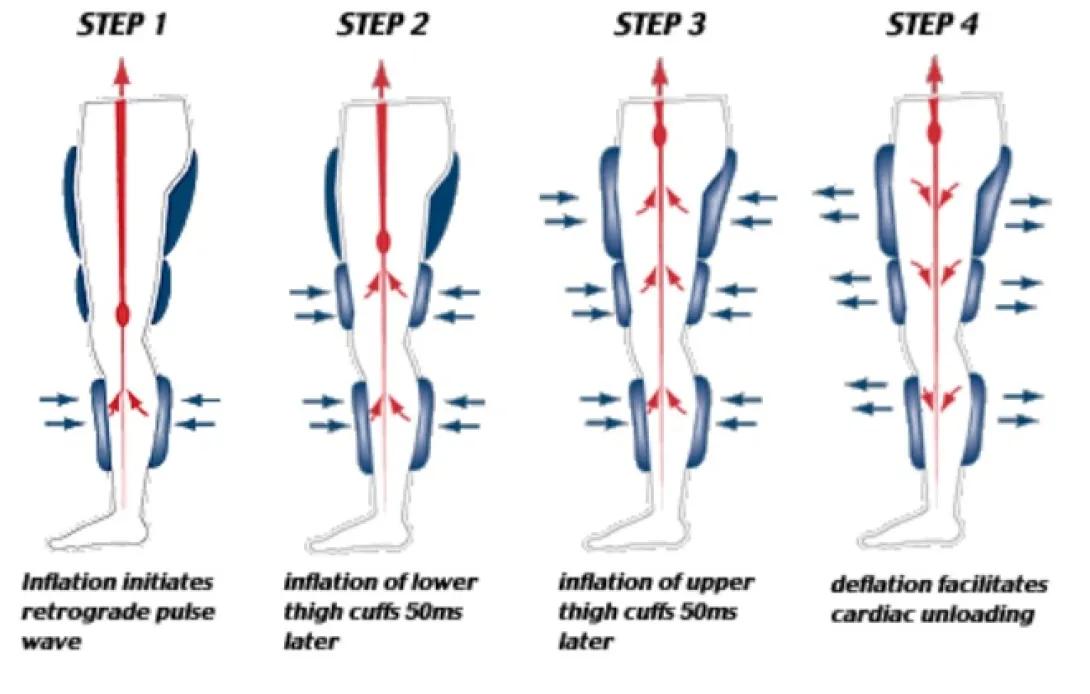
Step 1: Inflation initiates retrograde pulse wave
Step 2: Inflation of lower thigh cuffs 50ms later
Step 3: Inflation of upper thigh cuffs 50ms later
Step 4: Deflation facilitates cardiac unloading
The history of Enhanced External Counterpulsation (EECP) dates back to the 1950s when researchers identified that increasing coronary perfusion could enhance blood flow to ischemic heart tissue. This concept led to the development of the intra-aortic balloon pump (IABP), a significant advancement in treating cardiogenic shock.
In the 1960s, a team at Harvard University, led by Dr. Birtwell, created a device that applied pressure to the lower extremities to improve cardiac output and perfusion. However, this early system was not widely adopted due to its complexity.
The technology evolved in 1976 when Zheng and colleagues introduced a more practical design using three compression cuffs, which inflated and deflated in sync with the cardiac cycle. By the 1980s, further enhancements included the incorporation of hip counterpulsation balloons, leading to a new generation of EECP devices recognized by the international medical community.
EECP gained FDA approval in the United States in 1995 for treating chronic stable angina. It has since been integrated into clinical guidelines from major cardiovascular organizations, including the American Heart Association and the European Society of Cardiology. Today, EECP is widely used as a safe, effective, and non-invasive treatment for coronary artery disease and heart failure, with ongoing research exploring its broader applications in cardiovascular care.
Our Approach
Michigan Medicine Preventive Cardiology offers an innovative approach combining EECP with cardiac rehabilitation in a single visit. This integrated program enhances overall wellness by providing EECP treatment alongside exercise, nutrition education, stress management, and behavior change strategies.
The treatment schedule includes 7 weeks of continuous treatments, which require daily visits for one hour, Monday through Friday.
Before beginning EECP, patients must:
Obtain a physician referral
Schedule pre-treatment appointments
Nursing assessment
Stress test
Orientation
The nursing assessment includes:
Review of medical history and contraindications
Provision of an angina diary to record chest pain episodes
Comprehensive information about EECP treatment
Completion of questionnaires to assess chest pain severity
Patients undergo two stress tests:
Pre-treatment: Establishes baseline exercise capacity and chest pain patterns
Post-treatment: Conducted after 35 sessions to measure improvements
These tests evaluate changes in exercise capacity and chest pain frequency, severity, and duration.
The orientation session includes:
Familiarization with the treatment room and equipment
Detailed explanation of the EECP process
15-minute trial run on the ECP machine
Opportunity to address patient questions
The first official treatment session begins the following day.
EECP is primarily for patients with disabling stable angina (Class III or IV Canadian Cardiovascular Society or equivalent) who are not suitable candidates for surgical intervention due to:
High risk of operative complications or failure
Unsuitable coronary anatomy
Excessive risk from co-morbid conditions
EECP is not recommended for patients with:
Valvular disease
Enlarged heart
Hemorrhage
Blood clots
Severe hypertension
Resting heart rate exceeding 120 bpm
Appointment Information
If you have been referred to EECP treatment and would like to schedule treatment at U-M Health, please contact us at 734-998-9590. Or visit the Make a Cardiovascular Appointment page to learn what to expect when you call us.
What are the potential benefits of EECP?
Potential benefits of EECP include:
Increased cardiac oxygen supply
Reduced chest pain
Improved exercise EKG response
Decreased nitroglycerin use
Increased energy and exercise duration
Long-term effects lasting up to 2 years
Patient Resources
Locations
-
Cardiovascular Medicine Clinic | Domino's Farms 24 Frank Lloyd Wright Dr. Ste 1300
Lobby A
Ann Arbor, MI 48106-0363Get Directions
Doctors

Sarah Kohnstamm, MD
Clinical Assistant Professor
Cardiovascular Disease, Internal Medicine
News & Stories

Young father survives aortic dissection after delayed diagnosis

C.S. Mott Children’s Hospital first in country to implant expandable heart valve during FDA review phase

Born with half a heart, headed to college with a full life

Expert complex heart surgery team saves baby with rare genetic heart condition

Treating a rare coronary artery aneurysm without open heart surgery