Aortic Stenosis
Aortic Stenosis
What is aortic stenosis?
Aortic stenosis is a condition in which the aortic valve does not open fully due to a thickening of the valve leaflets. This thickening makes it difficult for the leaflets to open and close, which decreases blood flow from the heart to the body. The condition may cause the heart to work harder to pump blood.
There are two main types of aortic stenosis:
Congenital aortic stenosis occurs in those who were born with a narrowed aortic valve, or a valve with two leaflets versus three. Symptoms may not appear until adulthood or later in life.
Acquired aortic stenosis develops later in life when calcium builds up on the edges of two or three of the flaps, causing them to fuse together. This may occur in people who have had rheumatic fever or as part of the aging process.
Aortic valve with stenosis
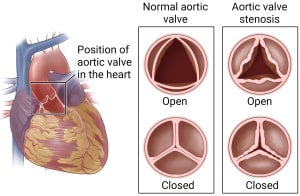
Normal aortic valve. A normal aortic valve opens fully to let blood flow into the aorta. The aortic valve has three flaps that work like a one-way gate. When the heart pumps, the aortic valve opens to allow oxygen-rich blood to flow from the left ventricle into the aorta. When the heart rests between beats, the aortic valve closes to keep blood from flowing backward into the heart.
Aortic valve stenosis. With aortic valve stenosis, the valve cannot open as wide as normal. Because the valve does not open as wide, the heart must work harder to pump blood through the valve.
What causes aortic stenosis?
Severe aortic stenosis is often unpreventable and may be related to:
- Age
- Buildup of calcium deposits which causes narrowing
- Radiation therapy
- Medications
- History of rheumatic fever or high cholesterol
Appointment Information
To schedule an evaluation with a Frankel Cardiovascular Center physician, call 888-287-1082. Or visit the Make a Cardiovascular Appointment page to learn what to expect when you call us.
What are the symptoms of aortic stenosis?
Patients with aortic stenosis may have no symptoms or may experience:
- Chest discomfort or tightness
- Shortness of breath
- Lightheadedness
- Dizziness
- Fainting
How is aortic stenosis diagnosed?
Most people find out they have aortic valve stenosis when their doctor hears a heart murmur during a physical exam. To be sure of the diagnosis, your doctor may want you to have an echocardiogram. You may have other tests to help your doctor judge how well your heart is working.
How is aortic stenosis treated?
Aortic stenosis can be treated either medically or surgically depending on severity and/or symptoms. Surgical treatment may consist of repair of the valve leaflets or replacement of the valve. Surgery can be either an open repair or minimally invasive, based on your individual case.
Open surgical aortic valve replacement
Open surgical aortic valve replacement (SAVR) is the treatment of choice for aortic stenosis patients. During the procedure, the valve leaflets are repaired or the damaged valve is removed and replaced with a new valve.
Minimally invasive transcatheter aortic valve replacement
For aortic stenosis patients who are not candidates for open-heart surgery, we offer multiple minimally invasive, percutaneous (through the skin) options for aortic valve replacement. Known as transcatheter aortic valve replacement (TAVR), the procedures involve the use of a catheter threaded through small incisions to access the valve leaflets and repair them or to access the damaged aortic valve and insert a new valve.
Locations
-
Cardiac Surgery Clinic | Frankel Cardiovascular Center 1425 E Ann St
Floor 3 Reception C
Ann Arbor, MI 48109-5856Get Directions
Doctors

Gorav Ailawadi, MD, MBA
Professor
Thoracic Surgery, Surgery

Steven Fredric Bolling, MD
Professor
Thoracic Surgery, Surgery

Kristopher Barrett Deatrick, MD
Clinical Associate Professor
Thoracic Surgery, Surgery, Pediatric Cardiothoracic Surgery

George Michael Deeb, MD
Professor
Thoracic Surgery, Surgery

Shinichi Fukuhara, MD
Clinical Assistant Professor
Thoracic Surgery, Surgery

Jonathan William Haft, MD
Professor
Thoracic Surgery, Surgical Critical Care, Surgery

Barbara Hamilton, MD, MS
Clinical Assistant Professor
Thoracic Surgery, Cardiac Surgery

Robert Bruce Hawkins, MD, MSc
Assistant Professor
Thoracic Surgery

Francis Dominic Pagani, MD
Professor
Thoracic Surgery, Surgery

Himanshu Jagdish Patel, MD
Professor
Thoracic Surgery, Surgery



News & Stories

Young father survives aortic dissection after delayed diagnosis

C.S. Mott Children’s Hospital first in country to implant expandable heart valve during FDA review phase
How a temporary heart pump can support high risk cardiac surgery

Treating a rare coronary artery aneurysm without open heart surgery

Fontan patient inspires as pediatric cardiology fellow