
Esophageal Atresia with or without Tracheoesophageal Fistula (EA/TEF)
Esophageal Atresia with or without Tracheoesophageal Fistula (EA/TEF)
EA/TEF stands for esophageal atresia (EA) with or without tracheoesophageal fistula (TEF). While EA/TEF is rare, occurring in 1 in 2,500 births, the two conditions are often present together and develop before birth. The cause of EA/TEF is unknown.
What is esophageal atresia (EA)?
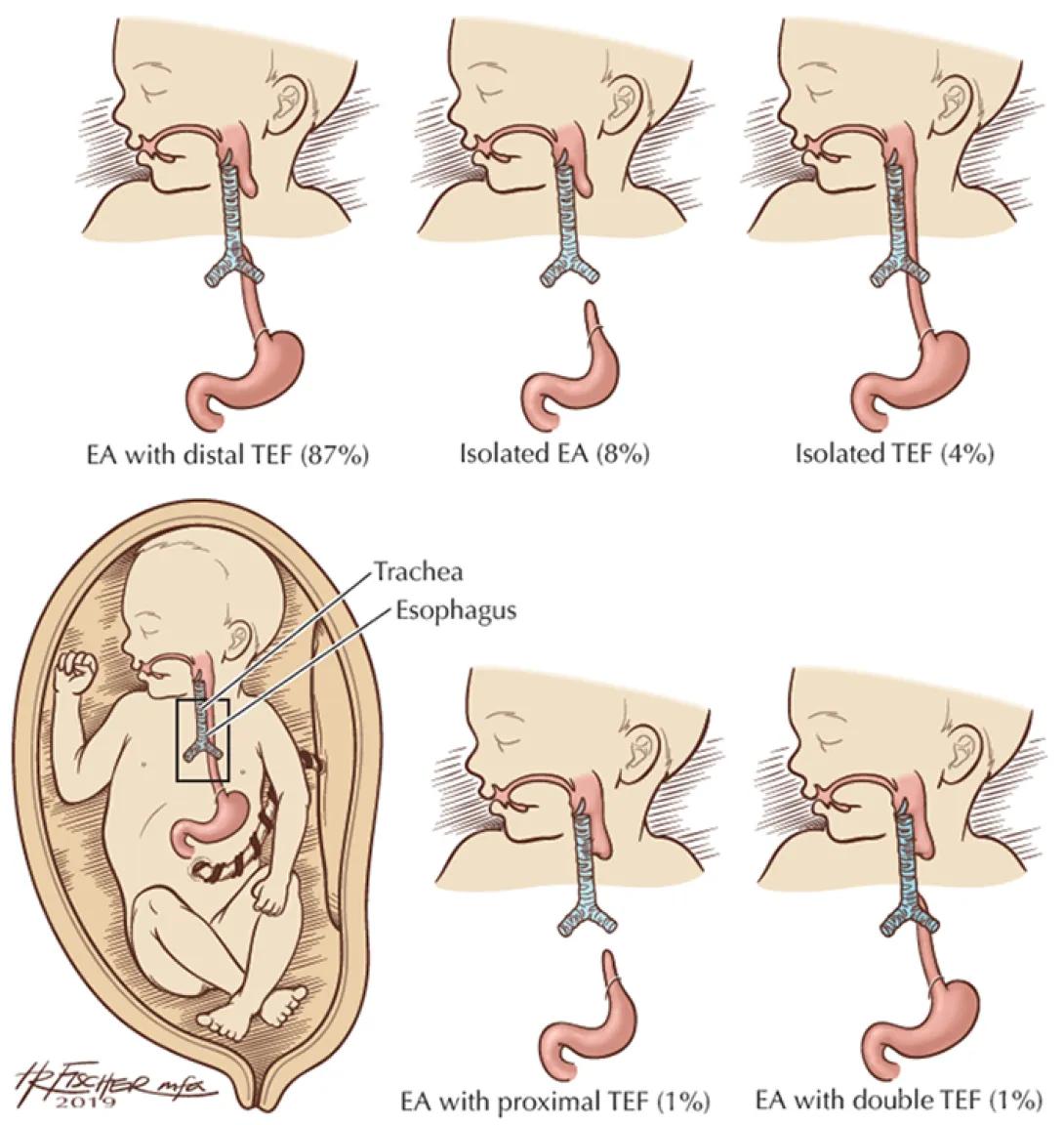
Esophageal atresia (EA) is an anomaly seen in babies when the esophagus, or swallowing tube, is not a complete open tube. Instead, there is a break in the tube and food/liquid will not be able to pass.
What is tracheoesophageal fistula (TEF)?
Tracheoesophageal fistula (TEF) is a connection most babies with EA have of one or both ends of the esophagus to the trachea (breathing tube). Pure EA without TEF is also possible (see diagram below for types).
Appointment Information
For more information or to schedule an appointment, call 734-763-4264.
How is EA/TEF diagnosed?
While diagnosis of EA/TEF prenatally can be difficult, it is a congenital (forming before birth) anomaly that the Fetal Diagnosis and Treatment Center can sometimes detect. Signs which may suggest EA/TEF include polyhydramnios (increased fluid in the uterus), an absent stomach, and a dilated esophageal pouch. These findings may or may not be present and EA/TEF is more often diagnosed after birth.
Prenatal management & fetal treatment
There are currently no fetal interventions offered for EA/TEF. With early detection, however, our team can counsel families prenatally on the potential signs, implications of those signs and what to expect after birth of the baby should the baby have EA/TEF.
Delivery & Treatment
Delivery should be at a center with pediatric surgical expertise capable of treating EA/TEF. There is no preference for vaginal or C-section delivery for a baby with suspected EA/TEF.
EA/TEF management after birth
Since a baby with EA/TEF will have other anomalies present at birth, a variety of tests will be conducted for a full assessment, including:
- A physical exam to evaluate for limb anomalies or an anorectal malformation
- An abdominal and chest x-ray to evaluate if there is a distal fistula (air seen within the stomach and bowel) and/or vertebral anomalies
- An echocardiogram to evaluate for congenital heart disease
- An abdominal ultrasound to evaluate the kidneys (renal)
VACTERL is an acronym used to describe the different birth defects that may be present at birth. VACTERL stands for:
V = Vertebral anomalies
A = Anorectal anomalies
C = Cardiac
T/E = Trachea-Esophageal fistula
R = Renal anomalies
L = Limb anomalies
Specific methods used to diagnose EA/TEF after birth include a chest x-ray showing an NG tube coiled in the esophagus, an x-ray test of the esophagus called an esophagram, and a bronchoscopy which is a procedure a doctor performs using a telescope and camera to examine the inside of the baby’s windpipe (trachea). These will be completed as needed after birth.
Treatment
Within the first couple days of life, the baby will undergo surgery for definitive repair (ligation, or closing off, of the fistula with attempt to put the esophageal ends together) by our pediatric surgery team.
Locations
-
Fetal Diagnosis and Treatment Center | Von Voigtlander Women's Hospital 1540 E Hospital Dr
Floor 9
Ann Arbor, MI 48109-4264Get Directions
News & Stories
Researchers discover what may be the root cause of preeclampsia, and how to fix it
Born under a pound: Two newborns beat extraordinary obstacles in the NICU

A complex fetal surgery to help a baby’s lungs grow

After 4 lifesaving heart surgeries, teen plays in Junior League World Series

Bentley’s Michigan Answer: Life-saving care. Life-changing outcomes.

