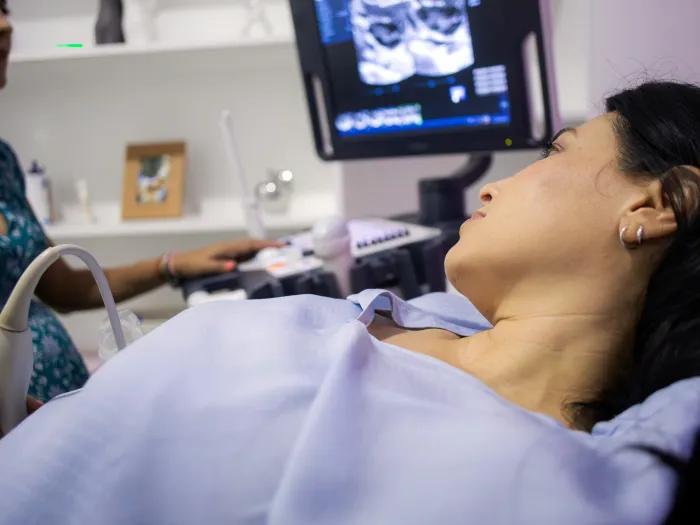
Urogynecology Program
Urogynecology Program
U-M Health Urogynecology Program physicians provide comprehensive surgical and non-surgical services for women suffering from any form of pelvic floor disorders.
Our Approach
Each of our Urogynecology Program physicians is a board-certified Urogynecology and Reconstructive Pelvic Surgery (URPS) subspecialist. The URPS subspecialty is a certification jointly administered by the American Board of Urology and the American Board of Obstetrics & Gynecology to physicians who meet rigorous training and patient care standards specifically in the treatment of women with pelvic floor disorders.
Our Urogynecology Program has been in existence for more than 25 years, breaking ground with a multidisciplinary urogynecologic approach to patient care and pioneering the use of robotic surgical techniques in treating women with pelvic floor disorders. Our doctors have a national prominence in research, patient care and advocacy for women. Today, our physicians see more than 1,000 new patients annually at three locations across the state of Michigan
Pelvic floor disorders often involve interconnected symptoms affecting multiple organs. When more than one organ is involved, multidisciplinary care is essential to effectively treat the underlying causes. Our multidisciplinary team includes OB-GYNs specially trained in pelvic floor disorders, along with physical therapists. We also work collaboratively with U-M urologists, gastroenterologists and colorectal surgeons to provide comprehensive care when needed. Complicated cases are presented at care conferences to ensure that all options of care are considered. Together, our faculty functions as a tightly knit team, sharing our expertise across multiple specialties to ensure each patient receives individualized care for their particular symptoms.
The Urogynecology team is on the leading edge of evidence-based treatment options for women with pelvic floor disorders, ranging from bladder training and physical therapy to office-based outpatient procedures and advanced minimally invasive surgery. Vaginal surgery has always been a safe, natural-orifice way to have surgery, and our physicians have also pioneered the use of robotic surgery for another minimally invasive, precise approach to pelvic floor treatment.
In addition, our surgeons have special expertise in complex procedures necessary to correct failed procedures, unique conditions or complications caused by prior procedures.
Pelvic organ prolapse and incontinence can be uncomfortable and embarrassing conditions, forcing many women to give up daily activities, exercising or socializing. It doesn't have to be this way. None of these things is normal as you get older, and no one has to live like that.
We understand the impact of these disorders on our patients and we also understand many of our patients find the idea of surgery a frightening one. We offer a large variety of treatment options, from lifestyle changes and medication to physical therapy and surgery. We offer newer treatment options – so even if nothing has worked in the past, we can still help. Our surgery options include minimally invasive procedures that result in little pain and offer a shorter healing time. No matter which treatment option is recommended, our compassionate and attentive team provides each patient with an individualized plan specific to her needs.
Who We Treat
The physicians provide comprehensive surgical and non-surgical services for women suffering from pelvic floor disorders. Most pelvic floor disorders fall into a few general categories:
These disorders often occur as a result of damage from childbirth, repeated heavy lifting, chronic disease or previous pelvic surgery. Although pelvic floor disorders become more common as women get older, they are not a normal or acceptable part of aging. The impact on a woman’s quality of life should not be considered a cost of growing older, and many of these disorders can be effectively treated.
Services
The Urogynecology Program offers new, more successful options to get you back to the life you want to lead. Each patient’s treatment is individualized based on her own personal needs, underlying causes of her condition, and lifestyle goals. We offer a coordinated team approach to improve symptom control and improve quality of life. Your providers will work with you to find the treatment that is right for you.
Physical therapy can help women with pelvic floor disorders improve the strength and function of their pelvic floor muscles. PT techniques that are often used for women with pelvic floor disorders include:
- Pelvic-floor relaxation/strength training
- Bladder/bowel retraining
- Exercises designed to stretch/strengthen different muscles, including the diaphragm
- Manual therapy
- Improvement/restoration of joint movement
- Biofeedback/electrical stimulation/pressure therapy
Our team includes specialists from the University of Michigan Physical Medicine & Rehabilitation program with cutting-edge expertise in designing exercise and rehab regimens to treat pelvic disorders. Your program will be tailored to you.
Don’t live in Ann Arbor? No problem. We work with a network of PT providers with special expertise in working with women with pelvic disorders throughout the state of Michigan so that you are able to receive therapy conveniently close to home.
We offer several non-surgical therapies that can be performed during a standard office visit. These often serve as a temporary measure before surgery, or can resolve the problem without surgery.
- Pessaries are devices that are inserted into the vagina to support the pelvic organs. After some brief training with your physician, a woman can usually take the pessary out and reinsert it herself. Pessaries are used to treat prolapse, incontinence or both. When fit properly, they are comfortable and don’t cause infections.
- Bladder injections featuring neurotoxins (like Botox) are injected into the muscle that lines the wall of the bladder and can help treat overactive bladder symptoms when they don’t improve with simpler treatments.
- Urethral bulking agents are injected at the intersection of the bladder and urethra to reduce urine leakage with exercise (i.e. stress urinary incontinence). You’ll leave the office leaking less and ready to get right back into life’s activities.
- Nerve stimulation sends small electrical pulses from a nerve near the tibial nerve in the ankle to the sacral nerve to help control urination urgency, frequency, and incontinence.
For patients for whom non-surgical therapies don’t provide desired relief, we offer a full spectrum of short-stay surgical procedures, including laparoscopic and robotic-assisted surgery.
We will work with you to determine what procedure is right for your individual needs, factoring in your lifestyle and health history. Please ask questions of your surgeon and be upfront with your concerns so that we can factor everything into the decision.
Three different types of surgical approaches are available.
- Vaginal surgery has a faster recovery time, no incisions, and causes less pain and blood loss than an abdominal surgery. Some types of vaginal surgery can be done without mesh, using dissolvable sutures to attach the top part of the vagina to a ligament deep in the buttocks. Women typically are able to go home the following morning from surgery with little pain.
- Robotic-assisted laparoscopic surgery, performed through small incisions with the use of a telescope camera, allows for faster healing and shorter hospital stays in place of larger incisions that were previously used. Our experience with robotic surgery has shown that patients experience less pain and scarring, lose less blood, are at less risk of wound infections and return to normal activities more quickly compared to traditional open surgeries.
- Abdominal surgery is performed through an abdominal incision, has a longer recovery time and generally causes more discomfort than vaginal surgeries, but may be your only option due to anatomy or other existing conditions. We can still use the smallest incision possible.
Procedures offered can include:
- Incontinence surgeries done via the vaginal approach
- Repair of bladder or bowel vaginal prolapse done through the vaginal opening without the use of mesh
- Vaginal hysterectomy and support of the vaginal canal
- Surgeries to repair prolapse but keep the uterus intact
- Repair of fistula connections between the vagina and other organs
- Robotic-assisted sacrocolpopexy to repair vaginal prolapse
We also offer special expertise in complex pelvic reconstruction procedures and surgeries to fix complications from prior procedures.
Appointment Information
To schedule an appointment, please call 734-763-6295.
Frequently Asked Questions
The Division of Urogynecolgy in the Department of Obstetrics and Gynecology at the University of Michigan is committed to providing consultation services, comprehensive treatment planning and a broad range of services for patients with urinary incontinence, pelvic organ prolapse, fecal incontinence and other conditions associated with the pelvic floor. For further information, you can contact us at 734-763-6295.
Fill out the questionnaire sent to your home prior to your visit or fill out the questionnaire at your first appointment. This is a long questionnaire, but it asks important questions about your reproductive and general health and family history. This information will help us help you.
Please bring relevant and important medical records, radiology reports or laboratory reports. Please hand-carry all medical records to your first visit.
- The doctor will review your questionnaire and conduct a thorough history of your symptoms as well as some physical exams and tests
- Pelvic exam
- Evaluation of pelvic support
- Evaluation for loss of urine or stool
- Possible placement of a catheter in your bladder to check for the amount of urine left after you void (post-void residual)
- Neurological exam
- Evaluation of pelvic muscles
- Discussion with your physicians about your diagnosis and possible treatment options
- Make follow-up appointments or schedule surgery
Locations
-
Obstetrics & Gynecology Clinic | Chelsea Professional Office Building Floor 1 Ste 101
Chelsea Multispecialty Clinic
Chelsea, MI 48118-1801Get Directions -
Obstetrics & Gynecology Specialty Clinic | Brighton Center for Specialty Care 7500 Challis Rd
Entrance 1, Level 2
Brighton, MI 48116-9416Get Directions -
Obstetrics & Gynecology Specialty Clinic | Northville Health Center 39901 Traditions Dr
Floor 2
Northville, MI 48168-9493Get Directions -
Obstetrics & Gynecology Specialty Clinic | West Ann Arbor Health Center-Parkland Plaza 380 Parkland Plaza Ste 210
Floor 2
Ann Arbor, MI 48103-6201Get Directions -
Women's Clinic | Von Voigtlander Women's Hospital 1540 E Hospital Dr
Floor 9
Ann Arbor, MI 48109-4276Get Directions
Doctors
Mary Fleming Ackenbom, MD
Clinical Associate Professor
Obstetrics & Gynecology, Female Pelvic Medicine & Reconstructive Surgery

John O De Lancey, MD
Professor
Female Pelvic Medicine & Reconstructive Surgery, Obstetrics & Gynecology
Pamela Susan Fairchild, MD
Clinical Associate Professor
Female Pelvic Medicine & Reconstructive Surgery, Obstetrics & Gynecology

Dee Ellen Fenner, MD
Professor
Female Pelvic Medicine & Reconstructive Surgery, Obstetrics & Gynecology
Christopher Hong, MD
Clinical Assistant Professor
Obstetrics & Gynecology, Female Pelvic Medicine & Reconstructive Surgery

Daniel McBurney Morgan, MD
Clinical Professor
Female Pelvic Medicine & Reconstructive Surgery, Obstetrics & Gynecology

Megan O'Brien Schimpf, MD, MHSA
Clinical Professor
Female Pelvic Medicine & Reconstructive Surgery, Obstetrics & Gynecology

Payton Claire Schmidt, MD
Clinical Associate Professor
Female Pelvic Medicine & Reconstructive Surgery, Obstetrics & Gynecology
News & Stories

Depression in OBGYN residents needs more attention, study suggests
PCOS has a new name

Who’s at risk for painful periods?

What to know about perimenopause and menopause

A heart attack 9 days after giving birth: Mother of 4 shares her SCAD experience