Making a difference with living donor kidney organs
How kidney transplantation using living donor organs and advanced treatment methods lead to better outcomes
5:00 AM
Author |
Approximately 90,000 to 100,000 people throughout the United States are currently on the national waiting list for a kidney transplant.
Sadly, each day an estimated 12 of these individuals will die as they await a suitable donor, which often can take five or more years.
The need for increased kidney donations has never been greater, says Mona Doshi, MMBS, Co-Medical Director of the University of Michigan Health Kidney-Pancreas Transplant Program and Medical Director of the Living Donor Program at the U-M Health Transplant Center.
She stresses the importance of access to kidneys from deceased donors as well as from living donors to meet the needs of those on the transplant waitlist.
Promoting organ donation is especially important each April, during National Donate Life Month as well as throughout the year, notes Doshi.
At U-M Health, this effort is evident not only in the Kidney Transplant Program but throughout the Transplant Center, one of the largest and most experienced solid organ transplant centers in Michigan.
As part of the Transplant Center, the Kidney Transplant Program provides a multidisciplinary team with decades of experience, the most advanced treatments and pioneering research — all committed to saving lives through organ transplantation.
“We see very complicated cases, including transplants for many patients who have been turned away by other centers,” said Doshi.
“And we have clinics throughout the state so that patients can be evaluated closer to home.”
Benefits of living donors
While both deceased and living kidney donors save lives, “Living donors are preferred for several reasons,” Doshi said.
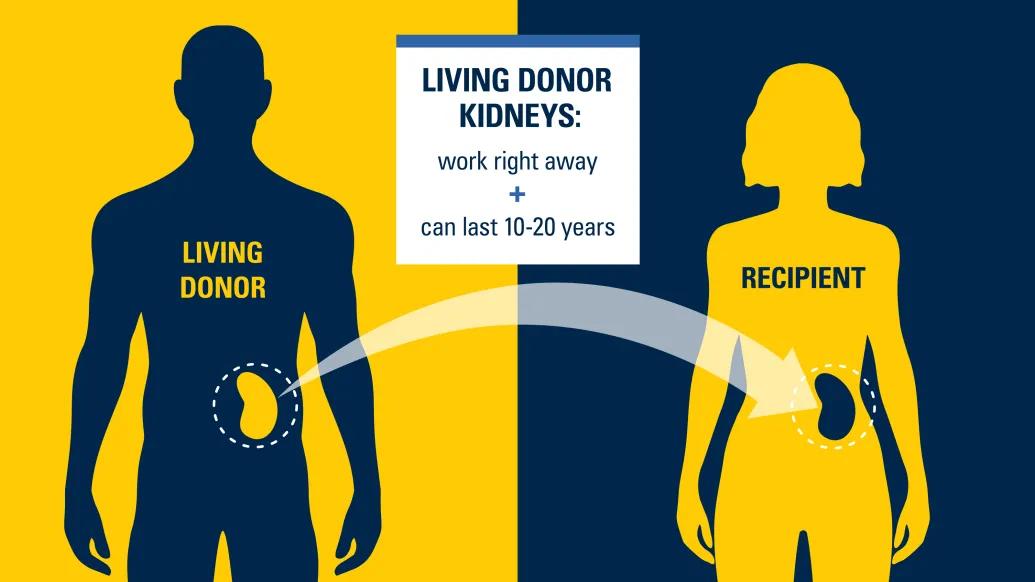
“A kidney transplant from a living donor is directed to a given recipient or patient so they can be quickly transplanted. The kidney from a living donor generally results in quicker recovery as it begins working immediately, usually without the need for dialysis. A patient implanted with a living kidney also tends to live longer,” noted Doshi.
According to Danielle Haakinson, M.D., Surgical Director of the Adult Kidney/Pancreas Transplant Program, “Depending on the individual quality of the donor, you can expect living donor kidneys to work right away and also to last 10 to 20 years. Deceased donor kidneys, again depending on the quality, may last five to 10 years.
“One of the most important surgical advancements in kidney transplantation is the use of robotics, especially involving a living donor organ,” said Haakinson.
We are putting compatible pairs together for optimizing outcomes, whether it is related to age mismatch, size mismatch or other issues of incompatibility.”
— Mona Doshi, MMBS
“The population that really benefits from robotic kidney transplantation is the obese population,” she added, noting the most common complications of a kidney transplant in an obese patient are hernias and wound infections, which can impact up to one-third of obese transplant patients.
“With robotic transplants, we can work with a much smaller incision in the upper area of the belly that is easier for patients to care for and quicker to heal. We can take that wound complication rate down to less than a 5-percent range.”
Wound infection following a kidney transplant also impacts how well the kidney functions in the long term, says Haakinson.
“To ensure these patients have the best transplant possible, we want to avoid those wound issues. This is part of our patient-centered focus.”
To this end, U-M Health transplant specialists have made advancements in optimizing available kidneys and getting the right kidney to the right patient in a personalized sort of way, says Haakinson.
“Our program is focused on each patient’s pathway. We make sure we capture every opportunity for transplant for patients, and we really think about very nuanced questions: What is the patient’s urgency? How long can they hold out for a higher quality organ versus accepting something that we can make work and try to optimize things in the near term?”
Unique resources for donors and recipients
Promoting living organ donation is critical to the U-M Health Kidney Transplant Program. With this in mind, the program and its specialists are focused on offering resources to help both prospective donors and recipients in their decision-making process.
The U-M Health Paired Kidney Donation program is offered to patients who have identified a donor who, upon evaluation, is determined not to be compatible.
“We evaluate the donor to determine whether they’re a match,” said Doshi.
“If not, we might recommend our Paired Kidney Donation program in which the donor agrees to donate an organ to someone who is determined to be a match. We are putting compatible pairs together for optimizing outcomes, whether it is related to age mismatch, size mismatch or other issues of incompatibility.”
The program is also increasingly evaluating older donors to meet the needs of the older patients on the waitlist.
The U-M Health Kidney Transplant Program evaluates prospective donors in satellite kidney clinics throughout Michigan — including Traverse City, Grand Rapids, Lansing, Kalamazoo, Detroit and Rochester.
“We go to areas where the donor lives, helping them avoid travel to Ann Arbor and making it more convenient for them,” Doshi said.
A Peer Mentor Program provides donors and recipients with access to individuals who have successfully gone through transplantation or who have donated a kidney.
One of the most important surgical advancements in kidney transplantation is the use of robotics, especially involving a living donor organ.”
— Danielle Haakinson, M.D.
“These peers offer support and first-hand knowledge about the transplant experience,” said Doshi.
This often includes medical and emotional support to those donating and receiving a kidney.
As part of the Peer Mentor Program, a quarterly education resource known as Living Donor Facts and Myths is offered to patients, their family members and potential donors who can log in via zoom to learn more about kidney transplant.
The Kidney Transplant team partners with the National Kidney Foundation to sponsor Big Ask, Big Give — a zoom program in which individuals learn how to go about asking for a kidney or becoming a donor.
The Kidney Transplant program also partners with Give to Live, a private organization that helps individuals in need of a transplant get comfortable with talking with family members, friends, church members and others about donating a kidney.
A Kidney Transplant Education app educates potential transplant recipients, donors and caregivers about what it feels like to receive or donate a kidney.
An “Ask a Peer Mentor” feature gives users an opportunity to ask kidney transplant donors and recipients about their experience.
Advancing care through clinical trials and research
In addition to these resources, U-M Health kidney transplant specialists are actively involved in clinical trials and cutting edge research to advance patient care.
“Our very robust research infrastructure allows us to run important clinical trials at U-M Health,” said Haakinson, pointing to the AWAKE Trial as one example.
“With deceased donor kidneys, only about one-half of kidneys will actually work right away and may require weeks of dialysis after the transplant. The AWAKE Trial is focused on minimizing delayed function of transplanted kidneys.”
To optimize organ preservation from a deceased donor, perfusionists at U-M Health are focused on research involving a novel perfusion kidney pump that delivers continuous oxygenated preservation solution to the organs.
Through ongoing clinical trials and research, as well as innovative systems and advanced therapies such as robotic surgery and perfusion devices, the Kidney Transplant Program is centered around each patient’s journey, says Haakinson.
“We're figuring out ways to get people transplanted to both augment their quality of care as well as their experience. We want patients to feel like they're a part of the team — we’re all working together toward a successful transplantation experience.”
A virtual kidney transplant education program is scheduled for May 6 from 6:15 p.m. to 8:00 p.m. The program provides information on how to find a potential living donor. It is geared toward patients, families, friends or anyone interested in learning more about living donation. The program includes patient and donor stories as well as a panel of transplant experts. Get more information.

Health Lab
Explore thousands of health news & research stories by visiting the Health Lab homepage for more.
In This Story
Danielle J Haakinson
Clinical Associate Professor
Stay Informed
Want top health & research news weekly? Sign up for Health Lab’s newsletters today!
Featured News & Stories
Specialized care helps patient navigate rare liposarcoma diagnosis
Advancements and trends in lung transplantation

State of Michigan allows tax credit for private employers of living organ donors

Kidney transplant recipient celebrates 10 year anniversary at Transplant Games
A physician discusses the future of kidney transplantation