Spasmodic Dysphonia
Spasmodic Dysphonia
What is spasmodic dysphonia?
Dysphonia is the medical term for disorders of the voice. The condition is pronounced spaz-MOD-ic diss-PHONE-nee-yah. It is also known as laryngeal dystonia.
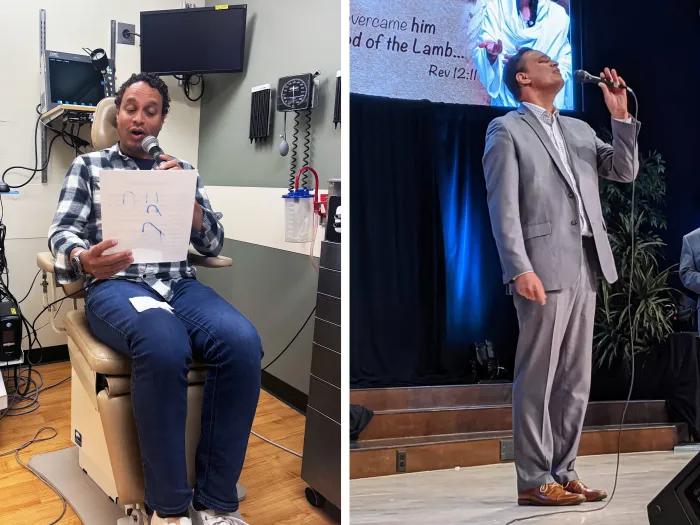
Spasmodic dysphonia (SD) is a neurological voice disorder that affects the voice muscles in the larynx, or voice box, causing it to “spasm.” These spasms cause the voice to be interrupted and affect voice quality. SD can cause the voice to break up or to have a tight, strained, breathy, whispery or strangled quality. It sometimes sounds like a vocal tremor.
Although the condition can start anytime in life, spasmodic dysphonia seems to begin more often when people are middle-aged. The disorder affects women more than men.
What causes spasmodic dysphonia?
There is no known cause for spasmodic dysphonia. Evidence suggests that the condition starts at the base of the brain in the basal ganglia, which regulate involuntary muscle movement. Genetic factors may put some people at greater risk of developing spasmodic dysphonia, particularly those who have family members with any form of dystonia (neurological movement disorders that cause twisting, repetitive movements or abnormal postures).
Appointment Information
Schedule an appointment by calling us at (734) 936-8051.
What are the symptoms of spasmodic dysphonia?
Typical symptoms of spasmodic dysphonia include:
- Voice breaks up
- Voice sounds breathy, whispery, strangled or tight
- Vocal tremor
- Hoarse voice
- Jerky voice
- Tremulous voice
- Intermittent voice breaks
- Effort required to produce voice
- Failure to maintain voice
- Breathy voice spasms
How is spasmodic dysphonia diagnosed?
Spasmodic dysphonia is sometimes difficult to diagnose because people with the condition often have symptoms that are similar to other voice disorders.
The University of Michigan Vocal Health Center team will ask you about your symptoms and medical history, and then do a thorough head and neck examination. During this process, we will also assess your vocal quality, efficiency and proper speaking technique.
We may need to do a procedure called a fiberoptic nasolaryngoscopy, which allows your physician to evaluate vocal fold structure and movement during speech and other activities. In this procedure, the physician passes a small, lighted tube through the nose and into the back of the throat.
How is spasmodic dysphonia treated?
While there is currently no cure for spasmodic dysphonia, we have found a great deal of success with these treatments:
- Voice therapy
- Botox injections
In severe cases, we may recommend augmentative and alternative devices, such as devices that amplify a person’s voice in person or over the phone, or special software to translate text to speech.
When conventional treatments are not working, we may recommend surgery on the larynx.
Locations
-
Otolaryngology Clinic | Brighton Center for Specialty Care 7500 Challis Rd
Entrance 1, Level 2
Brighton, MI 48116-9416Get Directions -
Otolaryngology Clinic | Northville Health Center 39901 Traditions Dr
Floor 2
Northville, MI 48168-9493Get Directions -
Otolaryngology Clinic | West Ann Arbor Health Center-Parkland Plaza 380 Parkland Plaza Ste 210
Floor 2
Ann Arbor, MI 48103-6201Get Directions -
Vocal Health Center | Taubman Center 1500 E Medical Center Dr
Floor 1 Reception A
Ann Arbor, MI 48109-5312Get Directions
Doctors

Jayson Scott Greenberg, MD
Clinical Assistant Professor
Otolaryngology
Norman Dertad Hogikyan, MD, F.A.C.S.
Professor
Otolaryngology
Robbi Ann Kupfer, MD
Clinical Associate Professor
Otolaryngology
Robert James Morrison, MD
Clinical Associate Professor
Otolaryngology
Jeffrey John Stanley, MD
Clinical Professor
Sleep Medicine, Otolaryngology
News & Stories

Rural-urban disparities in head and neck cancer

Biomarkers aid cost-benefit analysis of head and neck cancer immunotherapy
Gratitude inspires gift to improve survivorship care
Research may help better predict outcomes in kids with congenital cytomegalovirus

A link between e-cigarettes and oral cancer