Living Donor Kidney Transplant
Living Donor Kidney Transplant
As of August 6, 2025 there were more than 2,200 individuals on the waiting list for a kidney transplant in the state of Michigan and more than 92,000 people across the nation. Due to the number of people on the kidney waiting list and the short supply of deceased donor organs, the waiting period for a deceased donor kidney can be several years. Therefore, if you are waiting for a kidney, having a live donor will significantly decrease your waiting time for a kidney transplant.
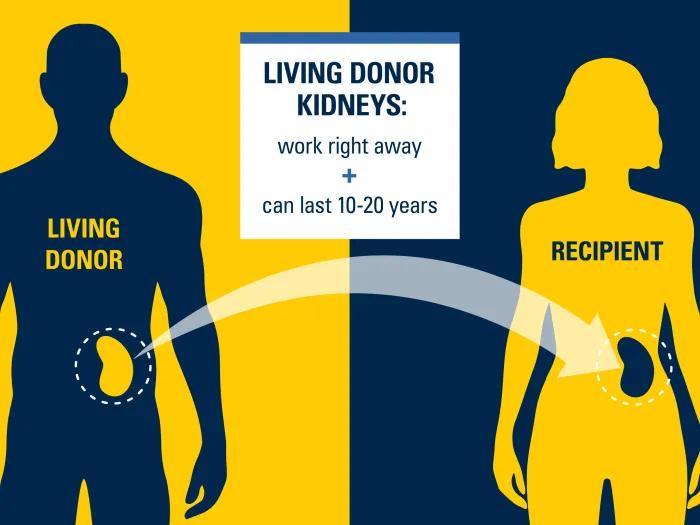
In addition to the ability to get a transplant sooner, living donors also provide a kidney that will last much longer than a kidney from a deceased donor. Your parents, adult-age children, siblings, other relatives, in-laws, and close friends can all be considered for living kidney donation. Sometimes people volunteer as living donors without a designated recipient and they donate a kidney to someone they do not know. Our transplant team is always available to ensure all your questions are answered thoroughly, whether you’re in need of a transplant or considering donation. We offer education and counseling to help you make important decisions.
Paired Kidney Donation Program
Many patients in need of a kidney transplant may have individuals in their lives willing to donate a kidney, but unfortunately their friends or loved ones cannot donate because they are not compatible. The Kidney Paired Donation program is offered to patients who have donors that do not match their blood type or who cannot accept a kidney from a donor because there is a strong chance they would reject the kidney. This type of kidney donation is called a "paired kidney exchange" or "kidney swap."
Who makes a good donor for kidney transplant?
Kidney donors do not need to be related to the recipient, although they often are related. They can be friends, coworkers, members of the same religious group or other organization, or any other type of relationship. While many people are willing to be living donors, not everyone can become a living donor. Donors are carefully and thoughtfully evaluated in order to avoid unwanted medical or psychological outcomes.
While the individual circumstances of each potential donor are considered and testing must be done to determine compatibility, all potential donors must be:
- At least 18 years of age
- Genuinely willing to donate
- In good general health and reasonably physically fit
Certain medical conditions can make it likely a person will not be healthy enough to be a kidney donor (e.g. diabetes, heart disease, or history of stroke) but many other conditions may be acceptable (e.g. history of certain types of kidney stones, heart murmur, history of certain types of cancer). It is best to ask rather than assume someone cannot be a donor.
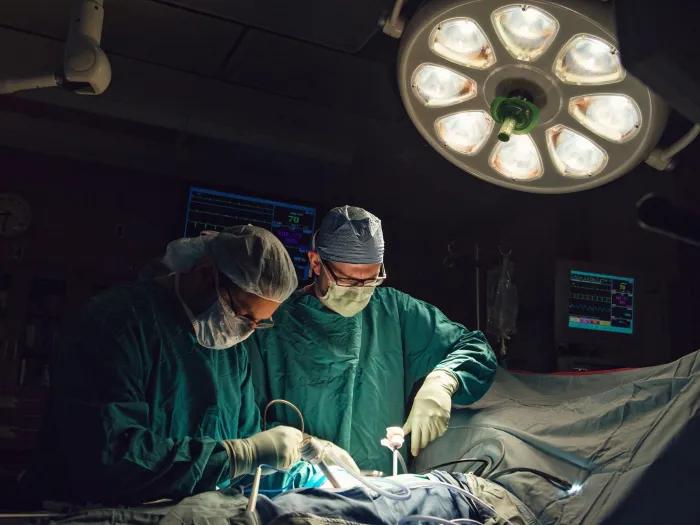
Individuals considered for living kidney donation are usually between 18 and 65 years of age. Gender and race are not factors in determining a successful match. Hypertensive donors over the age of 50 may be eligible under certain conditions. While the risk to the donor is minimal, there is always some degree of risk associated with any surgical procedure. The procedure is done laparoscopically which helps minimize discomfort and ease recovery after the procedure. Donors undergo an education process about the operation and its risks, and are able to confidentially decide not to donate at any time.
About the Transplant Center
The opportunity for a new life occurs every day at the University of Michigan Health Transplant Center. And since 1964, more than 13,000 patients have benefited from our devotion to the individual.
What to Expect
Once you've decided that you want to be a donor, you'll follow the steps below.
- Contact the Transplant Center: Individuals who wish to be considered to donate a kidney must contact the Living Kidney Donation Program at 1-800-333-9013 to indicate their interest in donation. The Transplant Center cannot initiate contact with potential donors until they declare their interest. Potential donors will speak with a member of the living donor team who will begin the process by asking questions that include demographic information, personal and family general health history, medications and social history.
- Blood Type Matching: Potential living donors are tested to determine blood type.
- Tissue Typing: Potential donors who are medically eligible will need to have blood drawn for tissue typing. Tissue typing determines compatibility with the recipient. If the donor and recipient are not compatible, they may be eligible for our paired donation program. The paired kidney donation program is offered to patients who have donors that do not match their blood type or who cannot accept a kidney from a donor because there is a strong chance they would reject the kidney. The patient and donor are then paired with other patients and donors to find matches.
- Pre-Donation Evaluation: Potential donors identified to move forward in the process will be given an appointment in the Kidney Evaluation Clinic. During this appointment the potential donor will be assessed by a nephrologist, a transplant surgeon and a social worker. In many cases, all required testing can be accomplished on the day of evaluation. We will not disclose any of your private health information to anyone (including the recipient) without your explicit approval.
Living donors are free to confidentially withdraw at any time during the donation evaluation process and are not obligated to donate.
Learn more about transplantation in the U-M Health Patient Education Library
Donor Resources
For individuals considering becoming a living donor, and for patients who want to know more about living donation we offer:
- Living Donation Overview with Dr. Randall Sung
- The Kidney Transplant – Living Donor Education Class, a video which provides the information needed to help with the decision-making process.
- Facts and Myths of Living Donation with Ellen Deleruyelle, RN
You can begin the kidney donation process by submitting our Kidney Donor Interest Form (for Donors).
Peer Mentors
Our Peer Mentors have shared their journeys to assist you in making your decision to become a donor. Watch their videos below.
FAQs
- You can receive a transplant quickly and avoid or shorten time on dialysis.
- You can have surgery sooner and while you are healthy.
- A kidney from a living donor lasts longer than one from a deceased donor.
We understand this can be a scary and overwhelming task. Here are a few tips to get you started:
- Talk to your providers about living kidney donation.
- Discuss living kidney donation with your family and friends by sharing your story of how kidney disease has impacted your life.
- Share handouts or websites about living kidney donation with family and friends.
- Recognize that living kidney donation is not for everyone. Mention that everyone can help by sharing your story so more people are aware. This can increase your chance of finding a living donor.
- Have a loved one or a friend become a Champion for you. This Champion can help spread the word of living kidney donation by sharing your story.
For more information or questions, please speak with a Living Donor Coordinator.
Tell any interested donor to contact our office to speak with a Living Donor Coordinator.
No. All you need to do is to find someone willing and healthy to donate to you. We will take care of matching the right donor for you. Potential donors who are not the same blood type can still donate a kidney through the Kidney Paired Donation Program (KPD). You will receive a compatible living kidney transplant through the KPD program.
A face to face conversation with family and friends is always a great start. You can also post your story on social media, talk to members of worship, share at work, etc.
You might be surprised to know that we are seeing an increased number of potential donors who do not know their recipients. They learn about them through a mutual friend, work, at church/temple or on social media. We know you are not asking for an item or money that you can return. Their gift can better your life so you can help others. It’s all about paying it forward. People believe in it.
- Contact the Living Donor Office - complete initial health intake – Anyone interested in donation should contact us.
- Complete an education class to understand the process of donation.
- Complete a formal evaluation
Costs related to the living donation evaluation process and surgery are NOT paid by the donor. Costs are covered by the Transplant Center. The non-direct costs associated with Living Donation (travel, lodging, lost wages, etc.) may be covered by a federal grant through the National Living Donor Assistance Program (NLDAC).
Donors are generally discharged from the hospital the day after their donation surgery. The expected recovery may vary from 4-8 week’s post-donation depending on the job and lifestyle of the donor.
Locations
-
Transplant Clinic | Taubman Center 1500 E Medical Center Dr
Floor 1 Reception G
Ann Arbor, MI 48109-5334Get Directions
Doctors
Michael Joseph Englesbe, MD
Professor
Surgery
Daniel Richard Kaul, MD
Clinical Professor
Infectious Diseases, Internal Medicine
David Berrey Kershaw, MD
Professor
Pediatric Nephrology, Pediatrics
John C Magee, MD
Professor
Surgery, Transplant Surgery
Laura Heyns Mariani, MD
Associate Professor
Nephrology, Internal Medicine

Silas Prescod Norman, MD
Clinical Professor
Nephrology, Internal Medicine
Paul Picton, MD
Clinical Professor
Anesthesiology
Jeffrey D Punch, MD
Professor
Surgery, Surgical Critical Care, Transplant Surgery
Kyle Hershey Sheetz, MD
Assistant Professor
Transplant Surgery, Surgery
Christopher John Sonnenday, MD
Professor
Surgery, Surgical Oncology
Providers
Darren Patrick Freeland, PA-C
Physician Assistant
Physician Assistant
Crystal L Johnson, PA-C
Physician Assistant
Physician Assistant
Suzanne Cherise White Mielock, NP
Advanced Practice Nurse
Nurse Practitioner - Family, Nurse Practitioner
Michele Mills, NP
Advanced Practice Nurse
Nurse Practitioner - Pediatrics, Nurse Practitioner
Lavinia Adela Pacurar, NP
Advanced Practice Nurse
Nurse Practitioner
Shelly Riddell, PA-C
Physician Assistant
Physician Assistant
Irina Nikolaievna Sadovskaya, PA-C
Physician Assistant
Physician Assistant
Jennifer Marie Sharp, NP
Advanced Practice Nurse
Nurse Practitioner - Acute Care, Nurse Practitioner
John Hertler Tallman, NP
Advanced Practice Nurse
Nurse Practitioner
Karla Jean Willson, NP
Advanced Practice Nurse
Nurse Practitioner
News & Stories

Kidney transplant recipient celebrates 10 year anniversary at Transplant Games
Making a difference with living donor kidney organs
A physician discusses the future of kidney transplantation
Supporting Patient Experience and Caregiver Well-Being

Celebrating a kidney donation, to his best friend, a decade later