Essential Tremor
Essential Tremor
What is essential tremor?
Essential tremor, also known as familial tremor, is the most common movement disorder, affecting an estimated 5 percent of people worldwide. It can affect people of any age and tends to run in families. The tremor is usually in the hands and arms but can also be in the head, voice, chin, trunk and legs. Both sides of the body tend to be equally affected.
The condition is characterized by action tremors, meaning the tremors are noticeable when the affected area is moving, but improve when at rest. Most people seek treatment when the condition begins to interfere with their quality of life. Many primary care physicians can diagnose and treat this condition. However, if the diagnosis is in doubt, or if your medications are not working optimally, you may need to see a neurologist.
Our Approach
If you’ve been diagnosed with essential tremor, the U-M Health Movement Disorders Program offers the latest nonsurgical and surgical therapies delivered by a medical team who are leaders in their fields. We treat between 400 and 500 essential tremor patients every year. Our neurologists have specialized training in the evaluation and treatment of this condition and our Surgical Therapies Improving Movement (STIM) program is home to one of the largest deep brain stimulation centers in the Midwest region.
Appointment Information
To make an appointment, call 734-764-6831.
How is essential tremor diagnosed?
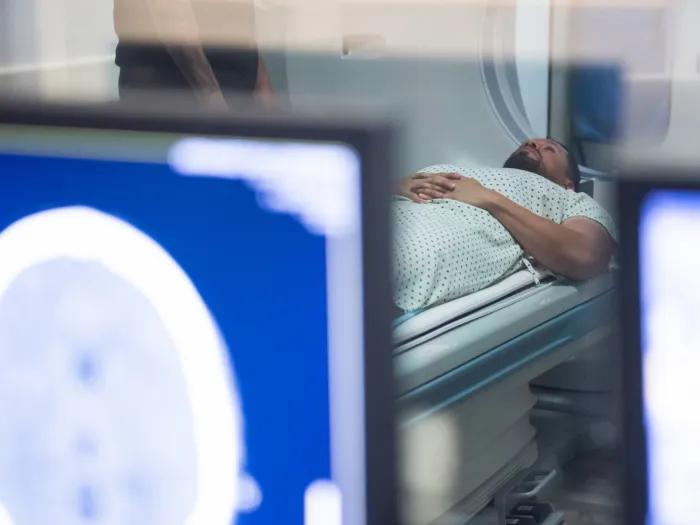
On your first visit, our neurologists will conduct a thorough history and neurological examination. We look at the tremors, what situations they occur in, which medications might cause them and at thyroid function. We may also take images of your brain.
How is essential tremor treated?
The first line of treatments for essential tremor is medications, such as propranolol and primidone. Many people will see some improvement from the medications, although they may not make the tremors go away completely. When essential tremor is interfering with quality of life and medications aren’t working, surgery is an option.
Deep brain stimulation is the most commonly-performed surgery for essential tremor and is highly effective. The Surgical Therapies Improving Movement (STIM) program is responsible for evaluating and treating tremor patients with deep brain stimulation. Our multidisciplinary evaluation program includes members from neurology, neurosurgery, psychology, psychiatry, speech pathology, radiology and social work. We believe the comprehensive nature of our program - unique in Michigan - leads to better patient outcomes.
Deep brain stimulation involves placing an electrode in a structure of the brain called the thalamus. It is typically placed on one side of the head, and connected by a wire that runs underneath the skin to a battery in the chest. When electrical stimulation is delivered to the brain, the tremor improves. It’s like a pacemaker for the brain, instead of the heart. Deep brain stimulation has several advantages over ablation (where cells in the brain are destroyed), including reversibility. At U-M Health, we have developed a wide array of ways to improve DBS, including special imaging tools that help doctors more accurately place the electrodes, and intraoperative motor and speech testing that result in fewer side effects for the patient.
Locations
-
Geriatric Neurology Clinic | East Ann Arbor Health & Geriatrics Center 4260 Plymouth Rd
Level 1
Ann Arbor, MI 48109-2700Get Directions -
Neurology Clinic | Brighton Center for Specialty Care 7500 Challis Rd
Entrance 1, Level 2
Brighton, MI 48116-9416Get Directions -
Neurology Clinic | Northville Health Center 39901 Traditions Dr
Floor 2
Northville, MI 48168-9493Get Directions -
Neurology Clinic | Taubman Center 1500 E Medical Center Dr
Floor 1 Reception C
Ann Arbor, MI 48109-5322Get Directions -
Neurosurgery Clinic | Taubman Center 1500 E Medical Center Dr
Floor 2 Reception G
Ann Arbor, MI 48109-5338Get Directions
Doctors
Roger L Albin, MD
Professor
Neurology
Kevin Showen Chen, MD
Assistant Professor
Neurological Surgery
Kelvin Lin-Yu Chou, MD
Clinical Professor
Neurology
Praveen Dayalu, MD
Clinical Professor
Neurology
Amy Ferng, MD
Clinical Assistant Professor
Neurology
Amelia Louise Heston, MD
Clinical Instructor
Neurology
Christopher Chauncey Spears, MD
Clinical Associate Professor
Neurology
Matthew Steven Willsey, MD
Assistant Professor
Neurological Surgery
Kara Jean Wyant, MD
Clinical Associate Professor
Neurology
News & Stories
Timely treatment helps former baseball pro survive on-field stroke with no complications
Researchers develop models to help diagnose ALS earlier through blood biomarkers
The faces of epilepsy: finding strength in hope
Study reveals the dual role for a protein critical for healing nerve damage
Teen with severe epilepsy finds seizure relief through ketogenic diet