DIY Digestion Activity
About Digestion
What does your body do with the food you eat?
We get hungry, we eat, our body does something with that food, the waste leaves our body...but what happens to that food while it’s in there? How does our body use it for energy? In this Camp Little Victors activity, we’ll learn how digestion works and even do a fun experiment that simulates the digestion process.
How does digestion work?
“Think of the concept of digestion as taking something big (like a piece of food) and breaking it down to something so small you can’t even see it,” says Jacob Bilhartz, MD, a pediatric gastroenterologist at C.S. Mott Children’s Hospital. “Digestion starts in our mouth when we chew our food. The act of chewing and the saliva in our mouth start breaking down the food.”
After we swallow the food, it travels down the esophagus into our stomach. “The parts of our body involved in digestion are essentially tubes surrounded by muscles that help move the food. These aren’t the kind of muscles you can see or work out. They are not the bulging bicep muscles or six-pack abs. These are involuntary muscles that sense the food in your body and get to work,” says Dr. Bilhartz.
“Your stomach is like a holding tank, and once the food moves from your stomach into the intestines, it mixes with chemicals produced by your liver and pancreas, as well as bacteria, to keep breaking it into smaller and smaller pieces. Eventually, those pieces of food are so small that they are absorbed into your intestines and sent out to fuel your body,” says Dr. Bilhartz. Your intestines then push the unused parts out as poop.
Tummy Aches and Farts
So what causes those occasional tummy aches? According to Dr. Bilhartz, some are caused by a person’s inability to break down the foods into digestible pieces. For example, people who are lactose intolerant cannot break down lactose in their body, so it causes stomach pain, bloating, and gas. Also think of your stomach as a small sack. If you eat too much at one time, that sack gets stretched out, which can also cause stomach pains.
And what about farts? When we swallow, we do swallow some air, which can eventually be released in a fart. Also, your body creates more gas when breaking down some foods. “The most popular example is beans,” says Dr. Bilhartz. “Creating gas and passing gas are also related to the bacteria in our belly. Our bellies are filled with good bacteria that help with digestion. Some times, depending on the food and the person, gas forms during that digestion.”
Activity
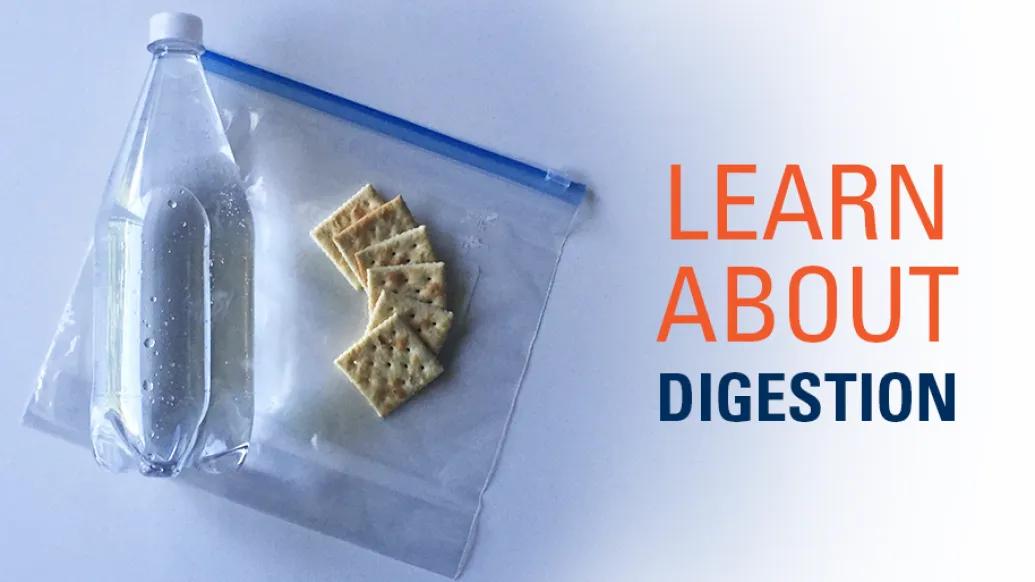
What You’ll need:
- Ziplock bags
- Saltine crackers
- Clear soda (like Sprite)
Instructions:
Place one or two whole saltine crackers in the bag and seal well. Here we’re starting with a whole piece of food. Now using your hands, start breaking the cracker apart in the bag. That mimics what happens when you chew your food. Now, add a small amount of soda to the bag and seal again. Just observe for minute as the soda interacts with the cracker pieces.
Now, gently squish the bag some more to mix up the cracker and soda. This is what happens to food in your stomach. The pieces of food mix with your stomach acids until they are broken down into very small pieces. In your stomach, the food is broken down into something so small that you can’t even see it.
Find more Math & Science activities from Camp Little Victors

Camp Little Victors
Camp Little Victors brings the fun of summer camp home, with easy, engaging activities for children and families.
Featured News & Stories
Bubble Snakes
Bubble Wands
Celebration Frog
Color-Swirling Milk Experiment