
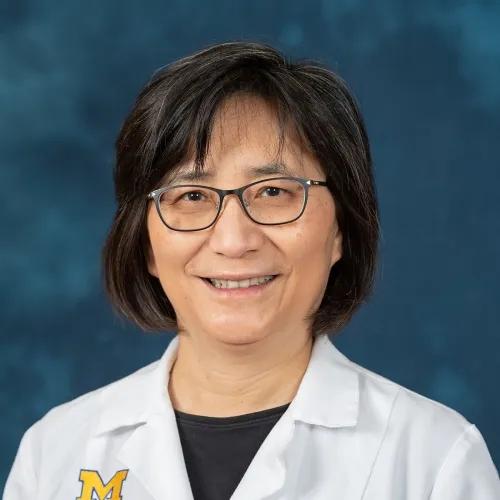
Grace Li-Chun Su, MD
To request an appointment call
Manage Your Profile
About
Dr. Su is the H. Marvin Pollard Collegiate Professor of Gastroenterology, III. In addition to her appointment at the University of Michigan, she is also the Associate Chief of Medicine for Subspecialty Care and Access as well as Chief of the Gastroenterology Section at the VA Ann Arbor Healthcare System.
Her research focus is on innovative approaches to specialty care and access. She also serves as the Director of the Morphomics Analysis Group at the University of Michigan where she leads a multidisciplinary collaborative of physicians, biostatisticians and engineers developing methods for analyzing medical imaging. By linking imaging features to clinical outcomes, they are able to use quantitative imaging data to improve the diagnosis and prognosis of patients with liver disease as well as hepatocellular carcinoma (HCC).
Dr. Su serves as the President of the American Association for the Study of Liver Diseases (AASLD), the leading organization of scientists and health care professionals committed to preventing and curing liver disease. She is committed to the vision of the organization to prevent and cure liver disease.
Areas of Practice
Locations
-
Hepatology Clinic | Taubman Center 1500 E Medical Center Dr
Floor 3 Reception D
Ann Arbor, MI 48109-2435Get Directions -
Medical Procedures Unit | University Hospital 1500 E Medical Center Dr
Floor 2
Ann Arbor, MI 48109-5051Get Directions
Insurance Accepted
University of Michigan Health participates with most health insurance plans.
Education & Training
Medical School or Training
Residency
Fellowships
Board Certifications
Professional Organizations
Research Overview
Dr. Su has a long history of performing clinical and translational research. She is the Director for the Morphomics Analysis Group (MAG). The Morphomic Analysis Group, a collaborative of researchers with surgical, medical, radiological, technological, engineering, and data expertise who are working together to document and analyze variation in human body factors. By utilizing the analytic morphomics platform, an innovative high-throughput, highly automated, anatomically indexed methodology for assessing body composition and organ measurements, they are able to convert routine clinical cross-sectional imaging (such as CT and MRI) to mineable data. By linking this data to clinical outcomes, they are able to leverage this previously unused data in the electronic medical records to improve clinical care, particularly for patients with liver disease. Using morphomics data, the group has created new methods for early detection of many different disease states including cancers such as hepatocellular carcinoma, colon cancer, pancreatic cancer, etc.
