
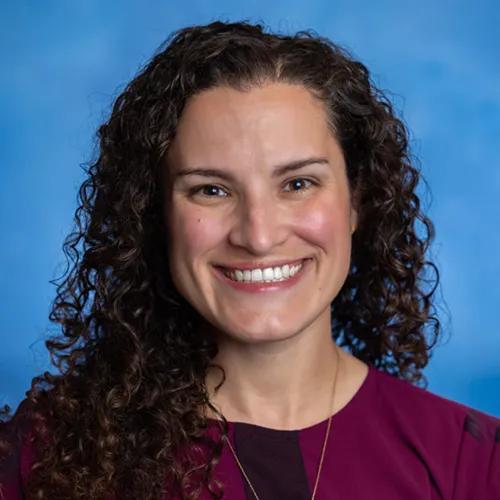
Stephanie Marie Munz, DDS
To request an appointment call
Manage Your Profile
About
Dr. Stephanie Munz earned her DDS from the University of Michigan in 2011, followed by a General Practice Residency (GPR) certificate at the University of Michigan Health System in 2012. She joined the University of Michigan School of Dentistry faculty the same year, serving as GPR Program Director from 2014-2021, 2022-2023. Since 2019, she has served as Associate Chair of Hospital Dentistry, was appointed as the Walter H. Swartz Professor of Integrated Special Care Dentistry, and in 2020 became Chief of Hospital Dentistry. Dr. Munz served as President of the Special Care Dentistry Association (2021–2022) and currently contributes to clinical teaching in Hospital Dentistry at Michigan Medicine and the Integrated Special Care Clinic at the School of Dentistry. Her clinical interests include comprehensive dental care, implant and prosthetic rehabilitation for patients with head and neck cancer, as well as dental care for individuals with cleft lip/palate, craniofacial conditions, trauma, and complex medical conditions. She is committed to developing the next generation of general practice dentists and advocating for oral health disease prevention and treatment through interprofessional collaborative practice.
Areas of Practice
Comprehensive general dentistry for patients with medical complexity and special healthcare needs, Implant and prosthetic rehabilitation of patients with head and neck cancer, cleft lip/palate and craniofacial conditions, and trauma
Locations
-
Dentistry Clinic | Med Inn Building 1500 E Medical Center Dr
Floor 2 Room C213
Ann Arbor, MI 48109-5827Get Directions -
Pediatric Dentistry Clinic | C. S. Mott Children's Hospital 1540 E Hospital Dr
Floor 3 Reception B
Ann Arbor, MI 48109-4219Get Directions
Insurance Accepted
University of Michigan Health participates with most health insurance plans.
Education & Training
Medical School or Training
Residency
Professional Organizations
Research Overview
Highlight the general dentist’s role in efficient, cost and outcome effective, value-based collaborative management for patients with medical complexity and special healthcare needs. Quality improvement and patient safety in complex oral care risk assessment. Evidence-driven oral disease prevention and clinical protocol development. Oral disease factors contributing to community-acquired infective endocarditis. Oral prosthetic effects on oral health-related quality of life. Interprofessional education and collaborative patient care.
