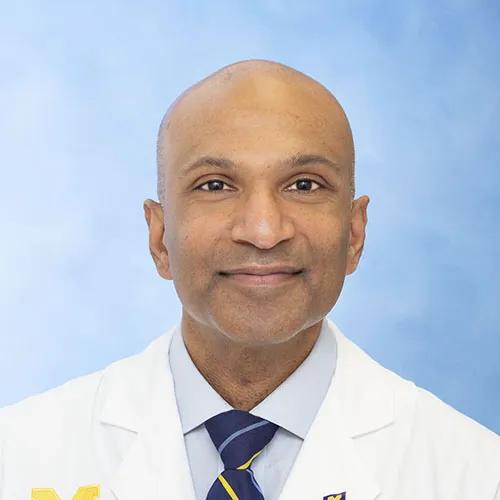
Joshi James Alumkal, MD
To request an appointment call
Manage Your Profile
About
Dr. Alumkal is the Wicha Family Professor of Oncology. He is the Leader of the Genitourinary Medical Oncology Section in the Hematology-Oncology Division and a Professor with tenure in the Department of Internal Medicine. He co-leads the Translational and Clinical Research Program in the Rogel Cancer Center. Dr. Alumkal’s main goal is to link laboratory and clinical scientists in order to develop more effective treatments for patients with advanced cancers, including men with prostate cancer whom he treats.
Dr. Alumkal attended the University of Texas (UT) at Austin where he graduated summa cum laude with a B.A. in Biology. He attended medical school at Baylor College of Medicine. He completed internal medicine residency training at UT Southwestern Medical Center, where he also served as Chief Resident. He completed medical oncology training at Johns Hopkins University followed by a post-doctoral fellowship focused on cancer epigenetics at Johns Hopkins University. Subsequently, Dr. Alumkal joined Oregon Health & Science University from 2007-2019. There, Dr. Alumkal was the Co-Leader of the Prostate Cancer Section and the inaugural holder of the Wayne D. Kuni and Joan E. Kuni Foundation Endowed Chair for Prostate Cancer Research.
Dr. Alumkal is a physician-scientist who was elected to the American Society for Clinical Investigation in 2019. The Alumkal Laboratory’s main emphasis is to understand how genes get turned off and on in advanced prostate cancers and how this process enables tumors to become resistant to standard treatments. The most important goals of Dr. Alumkal’s studies are to identify therapies that effectively target advanced prostate cancers and to conduct innovative clinical trials designed to validate the effectiveness of novel therapeutic agents.
In his free time, Dr. Alumkal enjoys spending time with his two children and his wife Kathleen Kemmer—who is also a medical oncologist and faculty member in the Hematology-Oncology Division at the University of Michigan—reading, running, and watching/playing soccer.
Areas of Practice
Prostate cancer
Locations
-
Urologic Oncology Clinic | Rogel Cancer Center 1500 E Medical Center Dr
Floor B1 Reception E
Ann Arbor, MI 48109-5913Get Directions
Insurance Accepted
University of Michigan Health participates with most health insurance plans.
Education & Training
Medical School or Training
Residency
Fellowships
Board Certifications
Professional Organizations
Research Overview
Dr. Alumkal is focused on developing a clearer understanding of what drives advanced prostate cancer so he and his team may develop more effective treatments for men with this disease.
Links
Patient Ratings & Comments
Visit our Physician Ratings & Comments page to learn more about how patient ratings are collected, calculated, and updated to help you make an informed decision when choosing the right physician for your care.
Patient Ratings
115 Patient Ratings
Patient Comments
June 20, 2026 - "Outstanding. Dr Alumkal Is genuine. Dr Alumkal Is a man of tremendous, always asks about my family " One of a kind'"
June 4, 2026 - "If we could give a 10 rating we would. Dr Alumkal was patient, kind and clearly an expert in his field. He explained everything in terms we could understand and never made the appointment feel rushed."
June 4, 2026 - "Dr Alumkal is an excellent,caring physician."
June 4, 2026 - "Dr. Alumkal explained [...] and did side effects both methods."
May 28, 2026 - "I would give Dr Alumkal a 10 on all aspects of patient care [...]. He was exceptional in all area of my visit. I brought along two important questions to ask him and he answered both prior to me asking the questions."
January 15, 2026 - "Excellent is a better rating than "very good" for Dr. Alumkal."
November 28, 2025 - "Dr. Alumkal is always professional and empathetic. Willing to listen and I never feel rushed. He takes time to answer any questions I have."
November 13, 2025 - "Dr. Alumkal was very professional and explained everything very well."
September 25, 2025 - "We are very glad Dr Alumkal chose to stay with Michigan Medicine. We trust his knowledge and experience and his takes the time to explain everything to us and answer all questions. He has excellent communication with his patients through the portal and seems to always have an eye on the portal. [...]"
September 4, 2025 - "Dr Alumkal is the best kind of doctor, he is kind , thourough, knowledgeable and caring. There isn't a better doctor, so what else can be said. If he is your doctor you are very lucky and you are in good hands."
Featured News & Stories
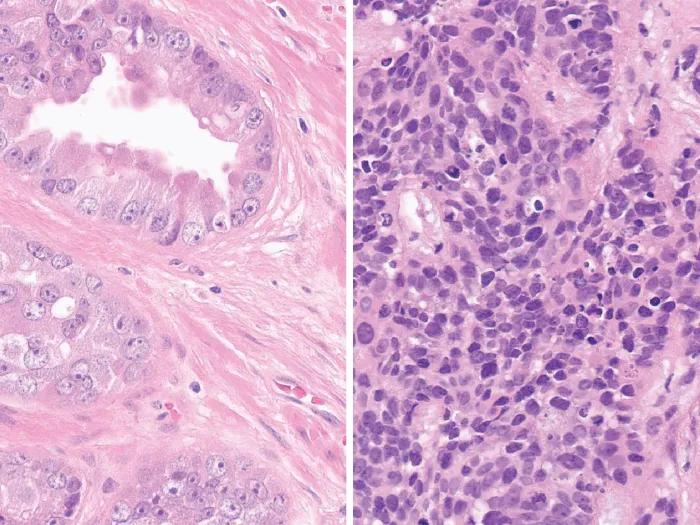
New drug combination may help treat advanced prostate cancer

Study sheds light on why some prostate tumors are resistant to treatment