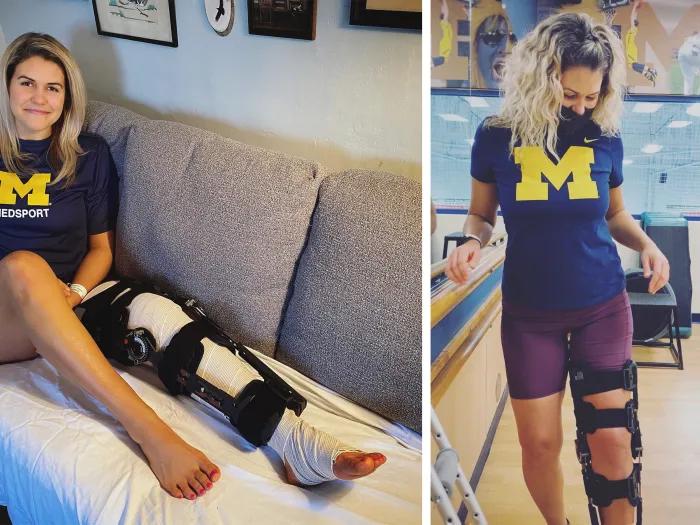
Sports Performance & Return to Play: Sports Medicine Care
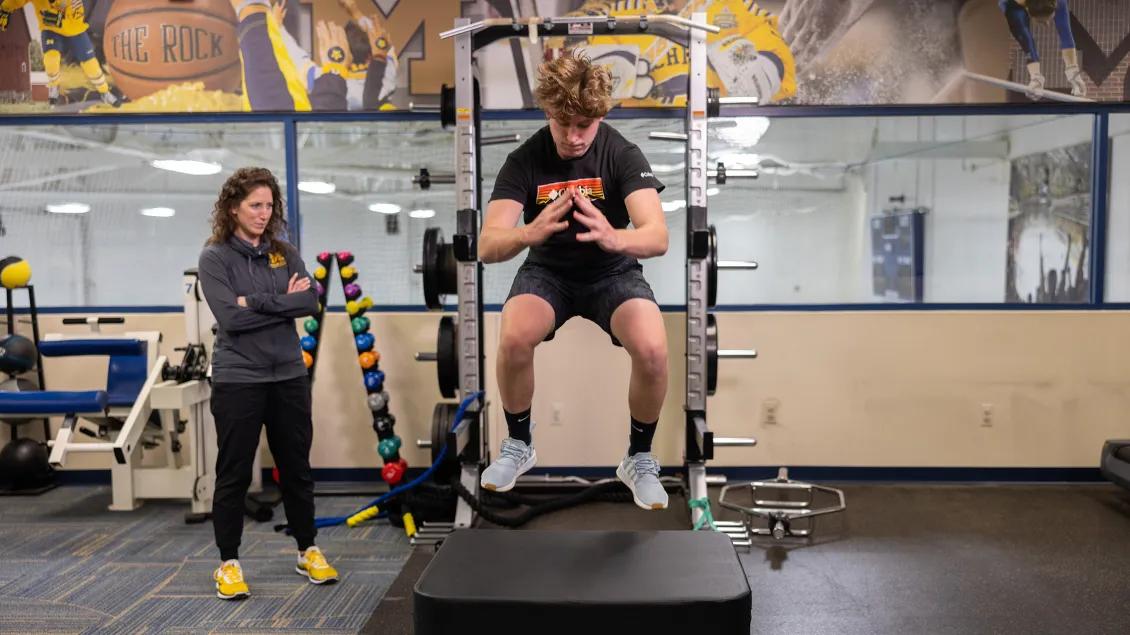
Return to Play
Your U-M Health Sports Medicine team helps you perform at your best and get back to the sport you love after injury, stronger and more confident than before.
Your Michigan Answer for Return to Play
Performance and readiness look different for every athlete and every sport. Our nationally recognized sports medicine team includes orthopedic surgeons, physical medicine and rehabilitation physicians, physician assistants, physical therapists and athletic trainers—all who work closely together to get you back in the game.
We serve athletes of every level, from recreational participants and high school competitors to collegiate, Olympic and professional athletes.
When you're ready to get back in the game, we make sure you're performing at your best.
Make an Appointment
Make an appointment with one of our U-M Health Sports Medicine experts by calling us at the number below.
You may also submit an appointment request via our form, and we will be in touch with you.
Find a Sports Medicine location close to you:
Meet Our Sports Medicine Experts
Get back to the game you love. Seek treatment for your sports injury from one of our experts.
How We Assess Your Performance & Readiness
Our sports performance and return-to-play assessments use advanced tools and proven methods to measure what matters most. Here's what that process can include.
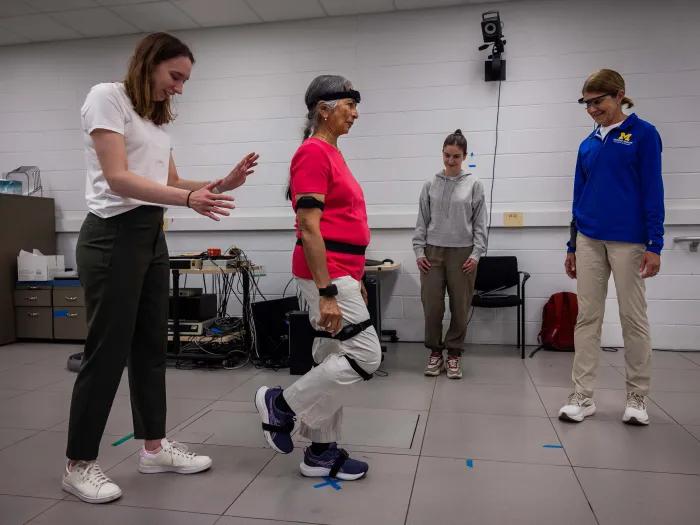
Motion Analysis: We capture and analyze how your body moves during sport-specific activities, identifying inefficiencies, asymmetries or movement patterns that could affect your performance or put you at risk for reinjury, things that simply aren't visible to the naked eye.
Strength Testing: Objective strength testing gives us a precise picture of where your strength is, where it isn't, and whether you've truly recovered the balance and power needed to perform and compete safely. We compare results to established benchmarks and, whenever possible, to your own pre-injury baseline.
Kinematic Analysis: Kinematics looks at the mechanics of your movement, including joint angles, timing, sequencing and coordination across your entire kinetic chain. This level of detail allows us to fine-tune your mechanics for both performance and long-term injury prevention.
Sport-Specific Assessments: No two sports place the same demands on your body, and your assessment reflects that. We tailor evaluations to the specific physical requirements of your sport, whether that's an endurance sport, contact sport, a sport that involves cutting and pivoting, or one that requires many overhead movements.
Are You Ready to Return to Play?
Completing your rehabilitation is a major milestone, but it's not the finish line. The Return to Sport Evaluation is a comprehensive, data-driven assessment designed to tell you and your care team exactly where you stand before you step back onto the field, court or ice.
The evaluation is a 60- to 90-minute assessment covering strength, mobility, jumping, hopping, agility, balance, control and endurance. It produces a video analysis, a detailed written report and a follow-up exercise plan that can be shared with your care team, family members, coaches and athletic trainers, along with an athletic profile and injury risk assessment to guide your return to play.
The program is designed for those recovering from knee surgery and lower extremity soft tissue injuries, from pediatric to adult ages, and from recreational athletes to elite competitors.
For the full program details, eligibility, and scheduling information, visit the Return to Sport Evaluation page.
Make an Appointment
To schedule a sports performance or return-to-play evaluation, patients may call our Contact Center at the number below. Referring providers can contact MLine.
Frequently Asked Questions About Return to Play
The evaluation is designed for children and adults recovering from knee surgery or lower-extremity soft tissue injuries, from recreational athletes up to elite competitors.
The evaluation is a 60- to 90-minute assessment covering strength, mobility, agility, balance and endurance. You'll leave with a detailed written report and a follow-up exercise plan.
You'll receive a video analysis, written report, and personalized exercise plan that can be shared with your care team, coaches, and athletic trainers. Your results will also include an athletic profile and injury risk assessment to guide your return to play.
You can call our Contact Center directly at 734-936-7070 to schedule. Referring providers can reach us through MLine at 800-962-3555.
No, it's a dedicated assessment to determine your readiness to return to your sport, not a treatment session. Your results will help guide the next steps in your care and training.
Why Choose U-M Health Sports Medicine
News & Stories

A concussion expert and football father discusses why he values teamwork over zero-risk
Why tendons heal so poorly and how researchers hope to fix them
To reduce chronic pain, a new digital program could help
AI supports home-based balance training
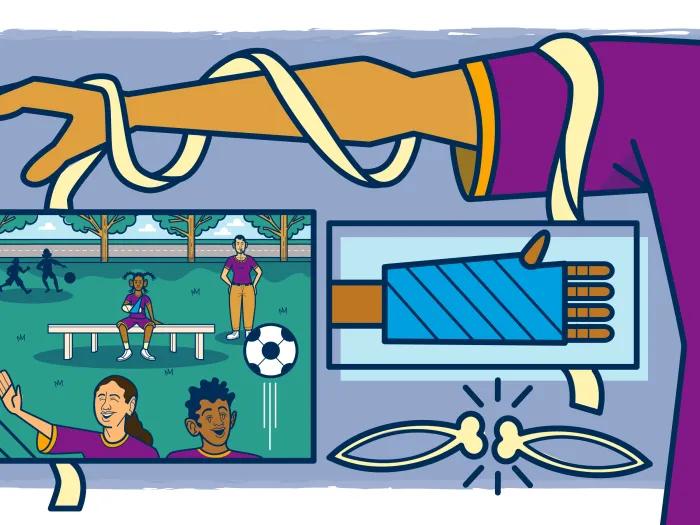
Properly treating, and recovering, from pediatric sports injuries