A night of two national titles for U-M, as scientists and basketball players both triumph
Team from Frankel Cardiovascular Center wins the STAT Madness virtual tournament for their work to understand and prevent deadly aortic aneurysms
7:30 AM
Author |
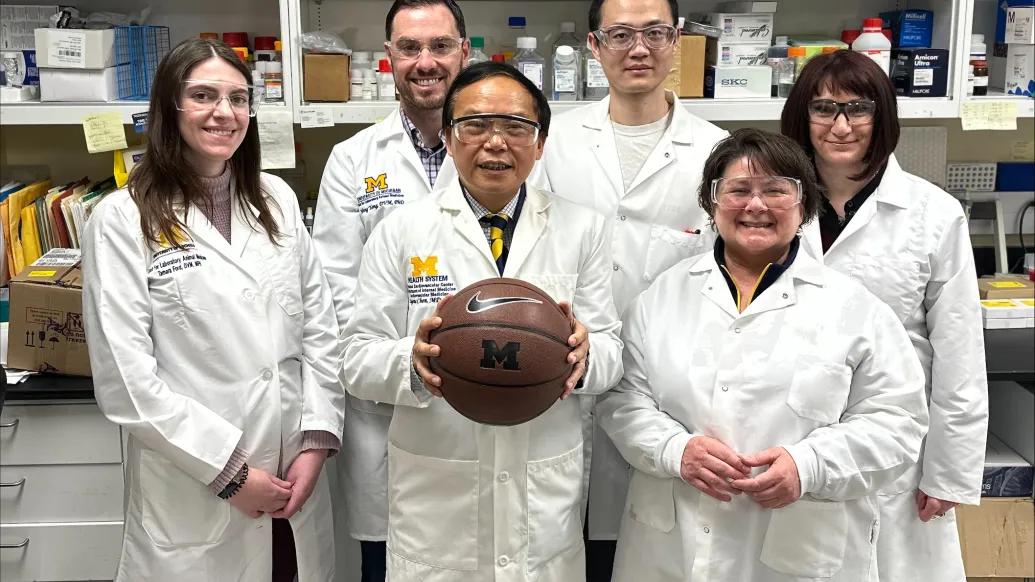
Just hours after the University of Michigan men's basketball team won their national tournament, a team of U-M scientists notched their own national victory, in a virtual tournament that brings attention to the importance of biomedical research in improving human health.
The team, based at the U-M Samuel & Jean Frankel Cardiovascular Center and led by Eugene Chen, M.D., Ph.D., emerged victorious in STAT Madness, run by the STAT News media organization.
Their paper published in 2025 in the journal Circulation showed that triglycerides play a key role in the formation of aortic aneurysms -- potentially deadly bulges in the wall of the body's largest blood vessel. It also showed that using drugs to reduce triglyceride levels in the blood of mice reduced aortic aneurysm risk. Yaozhong Liu, M.D., a postdoctoral researcher in Chen's group, is the paper's lead author.
The Chen lab's work, and the 63 other papers selected by STAT's editors, competed for public votes over the past month in head-to-head matchups that pitted top papers published in 2025 against one another.
Five other teams based at Michigan Medicine also made the initial bracket. One, led by Eva Feldman, M.D., Ph.D., made it to the semifinals for work on biomarkers for amyotrophic lateral sclerosis. Read about all the U-M teams picked for this year's bracket here.
While U-M's basketball players get to take home a trophy, Chen and his team get a prize more suited for a competition focused on public awareness of science.
They're profiled in a new article published on the STAT News website, along with the competition's second-place finishers from Florida International University.
It's an especially sweet victory for Chen, whose team's work has made it into the STAT Madness bracket twice before.
He notes that the aortic aneurysm work his team is doing in the laboratory is just one aspect of U-M's strength in studying and addressing this important and under-studied health condition, and the related condition called aortic dissection.
Aortic aneurysm and dissection are major causes of cardiovascular death in the United States, accounting for about 25,000 deaths each year and often presenting as fatal emergencies. Ruptured abdominal aortic aneurysm (AAA) is especially lethal, ranking 15th overall as a cause of death and 10th in men over 55, with total mortality of 80% to 90%, and about half of deaths occurring before hospital arrival. There are currently no effective drug treatments.
For patients who have aortic aneurysms and aortic dissections that are diagnosed before or just after rupture, the Frankel CVC is a top destination for surgical care and other clinical care through its MI-AORTA clinic.
The large number of patients seeking care at U-M from teams led by surgeons such as G. Michael Deeb, M.D., and Bo Yang, M.D., has also made it possible to study outcomes and innovations in care, and share those findings through publications.
Meanwhile, the IRAD registry of data on aortic disease was founded at U-M in 1996 by a team led by Kim A. Eagle, M.D., and has grown to become a worldwide resource. Its global website is here.
This is the second time in the ten years of STAT Madness that a U-M team has won. In 2019, a team led by Susan Shore, Ph.D., won for their work on understanding and developing a potential treatment for tinnitus. Their technology has been licensed to a company, Auricle, that is working to bring it to market.
Media Contact

Public Relations
Department of Communication at Michigan Medicine
In This Story
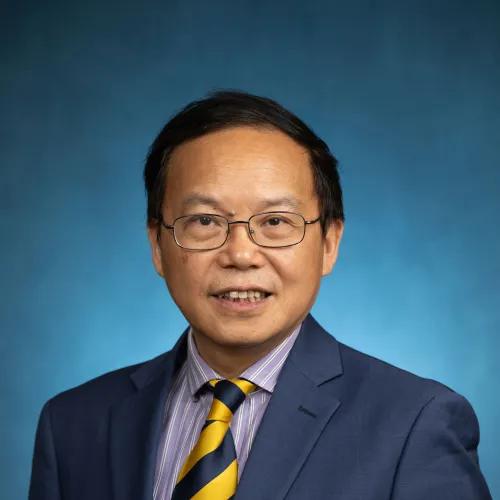
Yuqing E Chen
Professor
Related

Six U-M medical research teams picked for virtual science tournament
High triglycerides drive life threatening aortic aneurysms, study in mice finds
Featured News & Stories
$3.9 million NIH grant to fuel U-M effort to develop first targeted therapy for fatal childhood brain disorder

15 years of data will help uncover how flu spreads—and how to reduce its impact
Study outlines a new framework for direct cell reprogramming
Is the United States Lagging Behind Europe in Memory Improvement?
Engineered nanoparticles sensitize gliomas to radiotherapy