Triathlete’s prosthetic hand gets him back to living his best life
After a bike accident, the 39-year-old competitor overcomes the challenges he’s faced
5:00 AM
Author |
Jesus Moreno was a dedicated athlete living a good life in the heart of Detroit in 2014.
He spent his free time working out, competing in triathlons and riding his beloved motorcycle around town.
Nothing could slow him down.
“I loved running, cycling and swimming. I was living in Corktown because my job was pretty close. It was affordable living. It was great there,” he recalled.
But all that changed on May 11, 2014, when the motorcycle he was riding was hit by a bus, pinning him underneath it and severely injuring his hand.
Recovery seemed insurmountable to the then 28-year-old, but sheer determination, strong family support and the expertise of specialists at the University of Michigan Health Orthotics & Prosthetics Center helped him get back in the game.
The aftermath
What followed the accident was a blur, says Moreno, who was taken by ambulance to the nearest hospital.
In the next few days, he would learn his right hand had been “destroyed” — leaving him with only a thumb and one finger.
Despite wearing a helmet, he also sustained trauma to his head, causing additional health problems.
“My face was paralyzed. I couldn't eat. I couldn't talk. I basically had to start over with speech therapy. It was pretty bad.”
Determined to get better, Moreno’s cognitive health eventually began to improve.
“I wanted to run, or go for a walk, or anything I could physically do. For me, moving was my medicine.”
But it wasn’t the answer for the injured hand that caused not only tremendous frustration, but also a great deal of pain.
Moreno began diligently researching new treatment possibilities with the hope of finding the right solution.
“I started researching and found there are a lot of new technologies — robotic hands, even cadaver hands.”
Discovering the right care
Moreno’s research led him to University of Michigan Health and reconstructive surgeon Paul Cederna, M.D.
“Dr. Cederna’s credentials were incredible. When I went to see him, he had new technology that could help with the phantom pain that sometimes happens with an amputation. He was able to minimize my pain,” said Moreno.
While his pain subsided, the lack of function in his hand remained.
Moreno says his relationship with Cederna eventually gave him the confidence to consider amputating what remained of his hand, which included his thumb, index finger and wrist.
Moreno’s next step was meeting with Brian Kelly, D.O., director of the U-M Health Orthotics & Prosthetics Center, to discuss his future if he were to choose amputation.
The Orthotics & Prosthetics Center at University of Michigan Health is among the few University-based facilities in the country that offers comprehensive orthotic and prosthetic services.
“It's a center that does it all right here, so a patient doesn’t have to go to different locations,” said Kelly.
“Our experts include physicians, prosthetists and occupational therapists who are specially trained to assess each patient’s individual needs and custom design prostheses to meet those needs.”
The Center’s onsite prosthetists are health care professionals specifically educated and trained to measure, design, fabricate and fit prostheses for each patient.
“This type of coordinated care is what really makes us unique and special,” said Kelly.
Moving forward
Moving forward with the amputation surgery also meant Moreno’s introduction to patient education and support.
“U-M has monthly meetings where you get to meet other people with disabilities,” said Moreno.
“I started talking with other individuals who had no hand, and who used a hook. And there were all ages, all kinds of stages in life. That was very important because I was able to see how amputation was, even before experiencing it myself."
He says talking with the doctors at U-M and meeting other patients gave him the confidence he needed.
Kelly says he met with Moreno to talk about his future and his goals.
“Would he be able to get a prosthetic that would allow him to hang onto bike handlebars or lift weights? Would a prosthetic be more functional than his current hand? He wanted to make sure that his quality of life would improve if he made the choice to amputate his hand.”
Noting that Moreno is not your average patient, Kelly says once the two met, he was able to reassure him.
“I told him, yes, we make specific prosthetic components that allow you to hang on to handlebars, allow you to lift weights or hang from a pullup bar. We have the technology right here.”
With the ultimate goal of getting back to his former life as an athlete, Moreno knew then and there he had come to the right place.
Realizing success
Moreno’s surgery to amputate his hand was scheduled November 2017.
“I realized immediately that the amputation was successful because I had less pain,” he said.
Six months after surgery Moreno was fitted with a prosthetic.
“My relationship with Dr. Kelly has been great. I’ve been able to get the prosthetics I need, thanks to his care and guidance.”
Moreno says some of his early prosthetics were experimental.
“Since they knew I was active, we tried a swimming one that didn't quite work out. I still use my hook for everyday use and no prosthetic for swimming. I’m faster in the water without a prosthetic.”
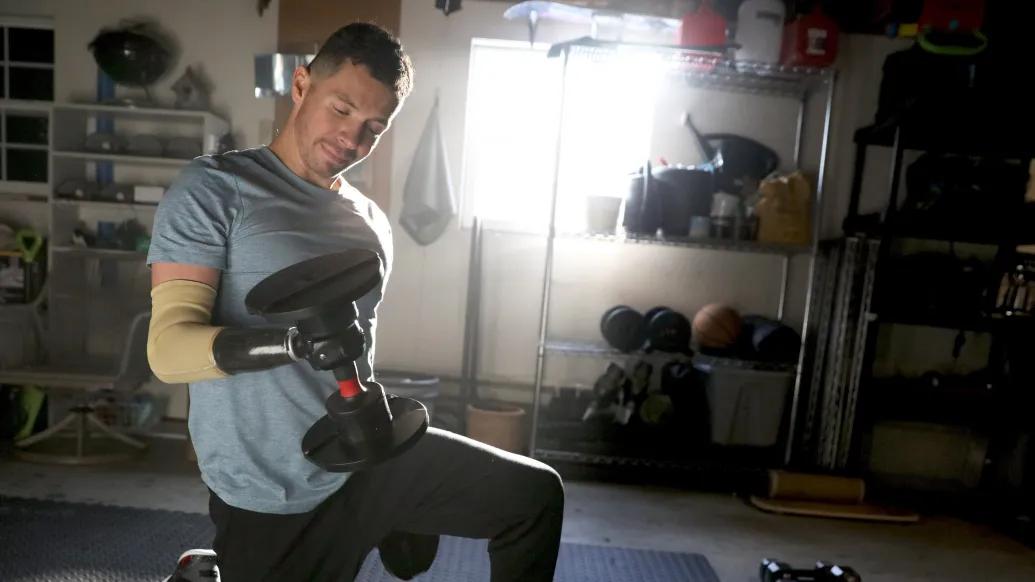
Moreno also has two prosthetics with different attachments for working out — one for lifting dumbbells and one that lets him hang from a pullup bar.
“On top of that,” he said. “I have two cycling prosthetics that attach to my bicycle and allow me to operate it in a safe manner. I’m blessed to be able to pursue my athletic endeavors and to become fit and healthy again."
His prosthetics have given him the courage and opportunity to compete in para-triathlons along with athletes with various disabilities.
“Our times are faster than some people with all their limbs,” he explained.
With local, regional, national and international competitions under his belt, he now has his eyes set on the 2028 Paralympic Games in Los Angeles.
“My quality of life has definitely improved since the amputation — that's a fact,” Moreno said.
“Before that, I was suffering. My mental stability was suffering. The amputation was one of the best decisions I’ve made, and meeting the U-M team really helped my quality of life.”
Looking toward the future
Kelly is excited about what the future holds for patients like Moreno.
“We keep getting more specialized and better and better as we go. There are new technologies being developed all the time. Dr. Cederna is doing research focused on using the nerves of the upper limbs to provide motor control and sensory feedback through the prosthesis, so you'll be able to feel your fingertips and feel temperature.”
“The field is evolving, and our department is heavily involved in this research. We’ve created the surgical technique. We're now trying to figure out how to create the technology for it," said Cederna.
Moreno is looking toward the future, as well.
“I'm a healthy individual competing in triathlons and living life. And that's what I’ve always wanted to do.”
Health Lab
Explore thousands of health news & research stories by visiting the Health Lab homepage for more.
Media Contact
Public Relations
Department of Communication at Michigan Medicine
Stay Informed
Want top health & research news weekly? Sign up for Health Lab’s newsletters today!
Featured News & Stories
Rethinking how clinicians learn to feel disease
Expanding camp adventure for all
A method to prevent falls before they happen
Giving with gratitude: planned gifts support nursing, research, and patient care
A smarter helmet for the smallest patients