After 25 procedures and constant fainting, patient finds long term relief
A rare combination of conditions required multidisciplinary teamwork
5:00 AM
Author |
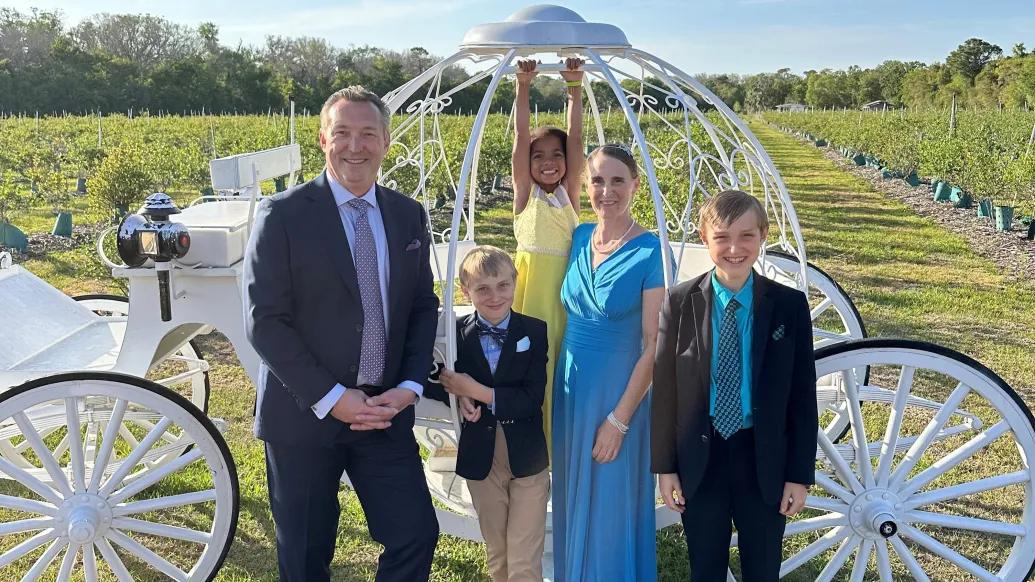
Before her surgery in Ann Arbor, Amy Benét’s left brachiocephalic vein was 100% constricted, while the right was between 92-95% closed.
Doctors explained this stenosis was seriously restricting the amount of blood getting back to her heart from her brain and upper body.
“I was like, ‘Wow, I'm kind of impressed that I am functioning as well as I am,’” Benét said.
That may sound like a wake up call for someone ignoring a condition.
Benét’s situation was anything but that.
The venous stenosis had resulted from the delicate and tenuous balancing of various medical challenges and treatments. And ultimately, it required an equally complex solution, executed carefully by a multidisciplinary Michigan Medicine team.
Benét has postural orthostatic tachycardia syndrome, commonly known as POTS, a condition which causes a large increase in her heart rate when she sits or stands due to fluid changes.
Medication didn’t help the symptoms in Benét’s case, so she initially found herself going to the emergency room multiple times per week.
There, she would receive IV therapy, a common treatment for POTS that alleviates a variety of its symptoms and effects, such as dehydration, low blood volume and nutrient absorption.
Her cardiologists put in a line for IV access, and, eventually, an IV port.
Since 2009, she had had some sort of indwelling device to assist with her IV treatments.
Those devices, however, caused complications of their own.
“I apparently had, to quote my primary care physician at the time, ‘multiple life-threatening situations,’” she said.
In 2010, the indwelling devices caused blood clots.
She started taking blood thinners, but the ports were also causing stenosis, the narrowing of her veins.
She required a venoplasty operation, in which a balloon is used to expand the vein.
Eventually, she required more such procedures — at least 25 by her count — and with increasing frequency.
The first venoplasty lasted several years.
The next one only a year.
Then they would last six months, three months, two months, until finally she required this procedure every six weeks.
She would also experience symptoms of superior vena cava syndrome, a condition caused by an inability of the body to return blood to the heart.
Benét experienced headaches, accompanied by a swollen feeling.
Her care team in Florida told Benét what she already knew: This strategy was reaching a point of diminishing returns.
“It was putting a Band-Aid on a big cut,” said Minhajuddin Khaja, M.D., M.B.A., the David M. Williams M.D. Research Professor, and professor of radiology and cardiac surgery at the University of Michigan Medical School.
“I don’t know that she would have been inevitably bedbound, but her life was significantly limited.”
Benét’s interventional radiologist in Florida had a relationship with Khaja that dated back to residency. He referred Benét to Michigan Medicine, and she traveled to Ann Arbor for tests and a consultation.
After undergoing imaging on a Wednesday, Benét met on Thursday morning with Khaja, who had a plan for an operation that could provide her with more lasting symptom relief.
Benét and her family were impressed with the speed and seriousness with which Khaja and his team approached her case.
“My father was with me, and he said, ‘Did the man sleep?’"
Khaja’s plan involved opening the occluded veins and inserting stents that would hopefully provide more lasting relief than the venoplasties.
Complicating Benét’s case, however, was an allergy to contrast dye, a necessary tool for the procedure.
The typical solution is the use of steroids to suppress the allergic response.
Benét, however, had a history of steroid psychosis, a serious psychiatric reaction to such medications.
Undeterred, Khaja began lengthy pre-operative coordination, scheduling meetings with the anesthesia and the intesnive care unit teams.
Meanwhile, back in Florida, Benét started getting calls from Michigan.
It was clear from the content of their questions that multidisciplinary communication was in full swing.
“The various people that were involved with my case were talking to each other, which I found good shocking,” Benét said.
“In the past, I felt like I had to relay the information between the people, and I always felt scared that I was not doing it correctly or that I was saying something wrong, and I may compromise my health because I wasn't able to explain something properly. So, I didn't experience any of that. I just kept being shocked by all of it.”
That emphasis on preparation and coordination carried over to the day of the procedure.
The entire team involved with her surgery introduced themselves to Benét.
As they went around the room, they would say their names, and a number assigned to them for coordination in the operating room.
When they got to Benét, she introduced herself as, “Amy, No. 25,” and got a big laugh.
The surgery was a success.
Benét was sedated longer than would be typical to allow the steroids addressing her contrast allergy to wear off.
When she did finally wake up, intubated in the ICU, the anesthesiologist and a nurse were there to help with her glasses and hand her a stuffed animal her children had insisted she take.
Benét called the equal focus on her health and her comfort another “good shock.”
“It was really great that we were able to pull it together and be prepared for the worst and expect the best,” Khaja said.
“And that’s what our multidisciplinary team did. Starting from our clinic visit with our nurse practitioner to getting everything set up with our cardiovascular anesthesia team and with our ICU team, it was very nicely done. I was proud of our team for making this work."
Now Benét, less worried about fainting or frequent procedures, can focus on doing more of the things she wants to do, including teaching art in her daughter’s class, volunteering and even instructing ballroom dance.
“What Dr. Khaja has done with the stents has completely changed my life and the lives of my husband and children,” she said. “I'm not going in for a procedure every six weeks that puts me out of commission for three or four days, which is just amazing.”
One year later, Benét and her father traveled to Ann Arbor to check on her stents through transvascular ultrasound, which allowed Khaja to look inside the stents.
After reporting that everything looked great, Khaja did a “show-and-tell,” walking them through the images.
Again, Benét and her family were impressed with the time and care displayed.
“Life for us will never be the same — in the best way possible,” Benét said.
Hoping other patients and their families will one day experience the relief she has felt, Amy Benét has started a fund supporting Khaja’s research.
Sign up for Health Lab newsletters today. Get medical tips from top experts and learn about new scientific discoveries every week.
Sign up for the Health Lab Podcast. Add us wherever you listen to your favorite shows.

Health Lab
Explore thousands of health news & research stories by visiting the Health Lab homepage for more.
Media Contact
Public Relations
Department of Communication at Michigan Medicine
In This Story

Minhaj S Khaja, MD, MBA, FSIR, FSVM
Clinical Professor
Stay Informed
Want top health & research news weekly? Sign up for Health Lab’s newsletters today!
Featured News & Stories

Distance, insurance, social factors may hinder access to lifesaving heart monitoring for children

Jalen Hurts’ blood clot diagnosis: doctors answer common questions

Is the United States Lagging Behind Europe in Memory Improvement?

Young father survives aortic dissection after delayed diagnosis
C.S. Mott Children’s Hospital first in country to implant expandable heart valve during FDA review phase