
Anna Megdell
Science writer and editor
Megdell joined the University of Michigan Rogel Cancer Center communications team in 2022. Prior to that she served as the natural sciences writer for the University of Michigan College of Literature, Science, and the Arts. Contact: [email protected]


Thrive
Pathway to Peace
Rogel Cancer Center support services offers a finger labyrinth—a small version of a walking labyrinth designed to be traced with your finger–can calm the nervous system and bring your mind to the present moment.

Thrive
Understanding Your Pathology Report
Get advice for what to do – and what not to do – when preparing for a surgery or biopsy, and when pathology results land in your patient portal.

Thrive
No One is You and That is Your Power
After a low-grade glioma diagnosis and surgery at 35, Claire Sloma reflects on community, letting go of control and redefining success in life and work.

Illuminate
The Answers in the Epigenome
Rogel Cancer Center researchers study how epigenetics regulates cancer-related genes, aiming to improve therapies, prevention strategies, and patient outcomes.

Health Lab
Leukemia drug secures FDA approval
Komzifti (ziftomenib), developed at Michigan Medicine, has been approved for patients with acute myeloid leukemia caused by the NPM1 gene mutation.

Health Lab
Additional testing can improve kidney cancer diagnosis
Michigan Medicine findings suggest further investigation of FISH-negative tests for renal cell carcinoma could lead to more accurate diagnosis.

Health Lab
Researchers find a targeted approach to shut down prostate cancer growth
Study shows a novel compound that degrades key proteins found in prostate cancer cells blocks oncogenic androgen receptor signaling.

Health Lab
Brain cancer patient finds a way forward
Sidney Ritchie’s aggressive brain cancer diagnosis has changed her life, and now, in her new reality, she finds meaning and purpose through connection, volunteering, and “showing up fully”

Health Lab
Routine blood test leads to life saving osteosarcoma diagnosis
Mike Nagle’s osteosarcoma journey, before he even had symptoms, was nothing short of a miracle, he explains in this article.

Health Lab
Study reveals mechanisms behind common mutation and prostate cancer
A study from the University of Michigan Rogel Health Cancer Center, published in Science, sheds light on how two distinct classes of mutations in the FOXA1 gene—commonly altered in prostate cancer—drive tumor initiation formation and therapeutic resistance.

News Release
Keeping in touch: how patients can contact the Rogel Cancer Center
How cancer patients and family can contact the University of Michigan Rogel Cancer Center

News Release
What to say when you don't know what to say
When your family or friend has cancer, it can be hard to know how to offer support. Even with the best intentions, finding the right tone or knowing what kind of help to offer can be tricky, especially when the stakes feel so high.

Health Lab
Re-purposed FDA-approved drug could help treat high-grade glioma
Avapritinib, an FDA-approved drug used to treat other types of cancer, also decreases aggressive gliomas in animal models and in an initial cohort of patients with high-grade glioma.
Health Lab
A collaborative approach to pancreatic cancer
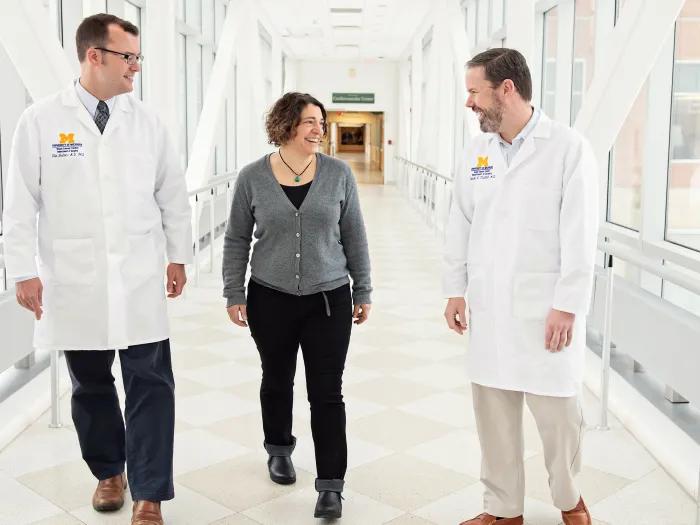
The Rogel and Blondy Center for Pancreatic Cancer is a center of excellence in pancreatic cancer research, combining pioneering research with innovative clinical care and an array of clinical trials. Center co-director Marina Pasca di Magliano explains that the key to a robust research program and responsive care lies in collaboration.

Health Lab
Research finds possible therapies to target oncogenic transcription factors in multiple cancer types
A study from the University of Michigan Health Rogel Cancer Center furthers research that suggests the potential of developing new cancer treatments to target oncogenic transcription factors by indirectly affecting their ability to access enhancer DNA in chromatin.
