For Health Providers

Committed to partnering with your practice

We want your patients to have the best experiences possible, especially when you choose to refer them to us. 

Call M-LINE: 800-962-3555
wide angle view of doctor taking vitals on patient

Referring Provider Resources

Female doctor wearing glasses and white hajib talking to young girl in exam room

Refer or Transfer a Patient

If you're a health professional who needs to transfer a patient to U-M Health, one call connects your patients with world-class services and advanced care.

Refer or transfer a patient
Reviewing medical images on a tablet

Upload Your Images

Securely transfer images electronically to U-M Health through Life Image, a third-party HIPAA-compliant image exchange network.
Upload your images
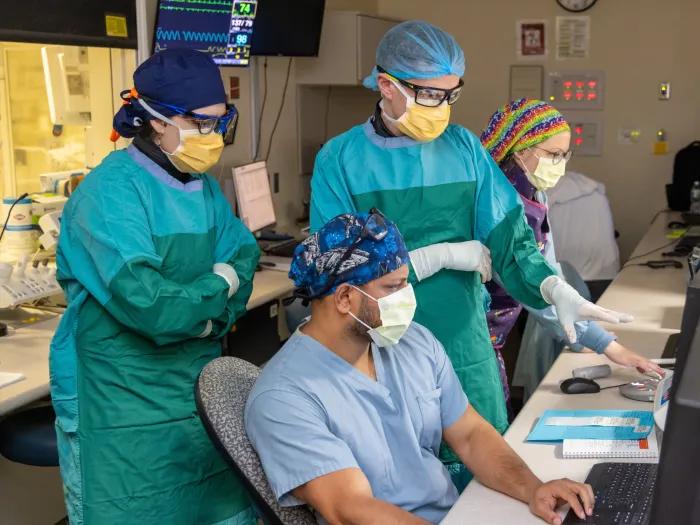
A group of people looking at a computer screen

Access Electronic Medical Records

There are several options for referring physicians to access their patients’ electronic medical records. Find the option that will best meet your practice's needs.

Access electronic medical records

Contact Us

M-LINE is a single, 24-hour, toll-free number for referring physicians and their staff seeking access to clinical services and faculty at University of Michigan Health.

Call M-LINE: 800-962-3555
U-M Health Physician Liaison Team

Meet the Physician Liaison Team

Our Physician Liaison team is dedicated to providing personalized service to community-based physicians.

Meet the team

Connect with Michigan Medicine

Opportunities

woman with red nail polish wearing a gold shirt holding an mobile phone

Clinical Colleague Newsletter

We are committed to communicating with our referring providers. Sign up for Clinical Colleague Newsletter email updates from U-M Health.

Sign up for email updates
woman at mic. with hand over her heart

Speakers Bureau

Michigan Medicine's Speakers Bureau is one way for our providers to engage with colleagues across the state of Michigan.

Request a speaker
Doctors-Around-A-Table

Join Our Team

Michigan Medicine provides world-class training, diverse opportunities, and the mentorship you need to ignite your career and shape the future of health care.

Explore Career Opportunities

Latest from Health Lab

See more Health Lab articles
nicotine packets close up in container
Health Lab

Lung health expert weighs in on Zyn and other nicotine pouches

Michigan Medicine’s MeiLan Han, M.D., provides her professional and medical thoughts on the use of nicotine pouches.
pink person talking to one orange person with question mark above their head confused and then a yellow person talking to the orange person and a teal person talking to the orange person
Health Lab

Many young adults may not be ready to manage their own health care

Many young adults may be entering adulthood without the practical skills needed to manage their own health care, suggests a national C.S. Mott Children's Hospital poll.
close up of shot injection in stomach pink skin teal shirt and pants yellow background
Health Lab

What should you know before starting a GLP-1?

A Q&A with Dr. Howard (Surgeon) and Dr. Seeley (researcher) about microdosing GLP-1 drugs answering common questions about the risks, what it entails and more.
bathroom toliets pattern and orange background
Health Lab

Got cyclosporiasis? How to take care of yourself and others

As the Cyclospora parasite outbreak sickens many, a primary care doctor’s top tips to get through it.
e-bike handles on road close up
Health Lab

E-bikes are faster than ever. Are families prepared for the risks?

As e-bikes and e-scooters grow in popularity, Michigan Medicine experts are warning families that many riders and parents may not fully understand the speeds these devices can reach or the injuries that can follow when things go wrong.
cells floating green black background strings many floating in backdrop
Health Lab

Scientists discover that bacteria use an understudied polymer found in all life to protect cell functions during stress

New study discovers that polyphosphate, a molecule that exists in all lifeforms but has to date been hard to study, could be a fundamental element worth exploring, say Michigan Medicine researchers.