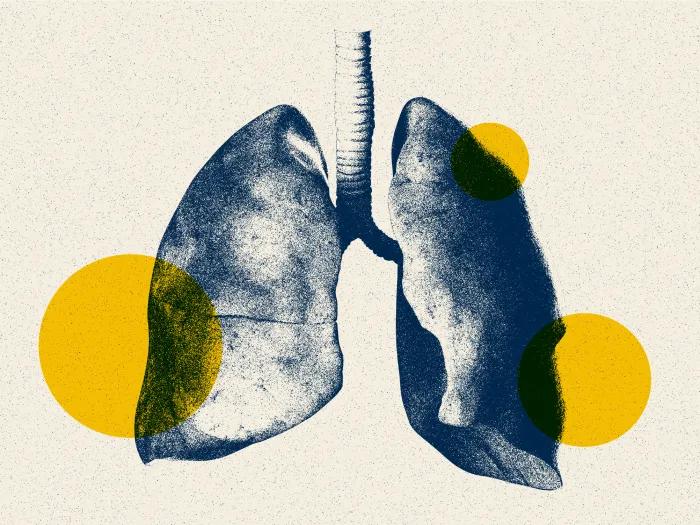
Pulmonary Fibrosis
Pulmonary Fibrosis
What is pulmonary fibrosis?
Pulmonary fibrosis is a scarring disease of the lungs and is one type of interstitial (occurring within the lung tissue itself) lung disease. There are over 100 types of interstitial lung diseases and although many result in scarring of the lung tissue, the treatment options can be very different, since receiving the wrong therapy can make your condition worse. That’s one reason it’s critical to be diagnosed at a high-volume center with specialized expertise.
The most common symptoms of pulmonary fibrosis are chronic dry cough and shortness of breath.
What causes pulmonary fibrosis?
It’s thought that pulmonary fibrosis may result from a variety of injuries to the lung. Some of these injuries include occupational and environmental exposures, drugs, poisons and certain connective tissue diseases. In most cases, there is no known cause and when a cause can’t be determined, the disease is called idiopathic pulmonary fibrosis. Around 100,000 people in the U.S. have pulmonary fibrosis and many more have other types of interstitial lung diseases.
Our Approach
At U-M Health, Pulmonary & Critical Care Medicine is a referral center, providing comprehensive care for people with interstitial lung diseases such as pulmonary fibrosis. We have also received funds from the National Institutes of Health (NIH) for more than 20 years to study the mechanisms that lead to scarring of the lungs and evaluate new treatments.
Our multidisciplinary team - which includes pathologists, radiologists and pulmonologists, cardiologists and rheumatologists - collectively diagnoses each patient and creates an individualized treatment plan for their specific needs.
Appointment Information
To schedule an appointment for pulmonary fibrosis treatment, contact us at 888-287-1084.
How is pulmonary fibrosis diagnosed?
We diagnose pulmonary fibrosis and other types of interstitial lung diseases by collecting a thorough medical history, performing a comprehensive exam, obtaining blood studies, and looking at the results from breathing tests and imaging exams like a chest x-ray or high resolution CT scan. In some cases a biopsy is needed either via a bronchoscopy (a flexible tube passed into the airways of the lungs to check for abnormalities) or minimally invasive surgery.
How is pulmonary fibrosis treated?
There are currently no FDA-approved therapies for pulmonary fibrosis. Treatment options can include:
- Drug therapies
- Oxygen therapy
- Pulmonary rehabilitation (an 8-week program to reduce the impact of chronic lung disease)
- Lung transplant
- Participation in research studies (clinical trials)
Clinical Trials
Clinical trials are an important part of our program, and can provide novel treatment therapies to patients before they are widely available. At any time, you can ask your doctor or any of our healthcare professionals about opportunities or you can view or sign up for studies that are currently recruiting participants.
At U-M Health, our scientists and doctors study the inflammatory cells to better understand how they are involved in the progressive scarring of the lungs. We are using basic science to understand cells, molecules and pathways that lead to pulmonary fibrosis, in order to identify new therapies. In addition, clinical testing is used to help us better predict the rate of progression in advising patients for drug therapy.
Our support group for idiopathic pulmonary fibrosis, Quest for Breath, brings together patients and their families to create community, raise awareness and more.
Locations
-
Pulmonary Clinic | Brighton Center for Specialty Care 7500 Challis Rd
Entrance 1, Level 2
Brighton, MI 48116-9416Get Directions -
Pulmonary Clinic | Taubman Center 1500 E Medical Center Dr
Floor 3 Reception C
Ann Arbor, MI 48109-5361Get Directions -
Pulmonary Clinic | West Ann Arbor Health Center-Parkland Plaza 380 Parkland Plaza Ste 210
Floor 2
Ann Arbor, MI 48103-6201Get Directions
Doctors

Elizabeth Anne Belloli, MD
Clinical Associate Professor
Pulmonary Diseases, Critical Care Medicine, Internal Medicine
Kevin Robert Flaherty, MD
Professor
Pulmonary Diseases, Critical Care Medicine, Internal Medicine

David Noel O'Dwyer, MB BCH BAO, PhD
Associate Professor
Pulmonary Diseases, Critical Care Medicine, Internal Medicine
Jamie Sue Votava Sheth, MD
Clinical Assistant Professor
Pulmonary Diseases, Critical Care Medicine, Internal Medicine

Bonnie Ren Shiaw Wang, MD
Clinical Associate Professor
Pulmonary Diseases, Internal Medicine, Critical Care Medicine
News & Stories

A gene discovery that changed cystic fibrosis care, and genetic research, forever
Surviving sepsis: New guidelines harness life saving evidence for treating adults
Child survivors of critical illness are missing out on timely follow up care

New hope for patients with idiopathic pulmonary fibrosis
Removal of ventilator breathing tube is delayed for some patients, posing health risks