Implantable Cardioverter Defibrillator (ICD)
Implantable Cardioverter Defibrillator (ICD)
What is an Implantable Cardioverter Defibrillator (ICD)?
Implantable cardioverter defibrillators (ICDs) are devices used to treat patients with heart arrhythmias that occur in the heart’s lower chambers, or ventricles, which can be life threatening.
ICDs are typically implanted in patients who have a weakened heart due to a history of heart blockages and/or heart attacks, or in those with heart muscle tissue that is enlarged or thickened. Occasionally, ICDs are implanted in patients who have an inherited heart defect that makes their heart beat abnormally.
How does an ICD work?
An ICD provides immediate therapy for a life-threatening arrhythmia where the heart is beating too quickly by providing a shock, or jolt of electricity — a treatment called defibrillation. The treatment needs to be immediate to prevent a person from passing out or dying if the heart is beating too fast and is unable to pump enough blood to the body. Patients describe the shock as a pain in either the back or chest area. The pain differs with everyone and lasts for a very short amount of time.
Most ICDs can also act as pacemakers if the heart is beating too slowly. In this role, the ICD continuously monitors heart rhythms and is programmed to deliver pacing pulses (which cannot be felt) to restore the heart's natural rhythm. The goal of these pacing pulses is to avoid the need for a shock. However, the ICD will deliver a shock to the heart if the heart’s natural rhythm is not restored during the pacing pulses.
The device, which is smaller than a deck of cards, is implanted under the skin in a pre-formed pocket in the left chest area. Leads (wires) are either inserted into the large subclavian vein and threaded into the heart (tranvenous) or placed under the skin above the heart (subcutaneous)
What are the types of ICD?
There are four types of ICDs:
- Single chamber
- Dual chamber
- Biventricular
- Subcutaneous
Single-chamber ICDs use a lead (wire) that is attached to the right ventricle to deliver energy, if needed. Dual-chamber ICDs use leads that are attached to the right atrium and the right ventricle.
The biventricular ICD provides cardiac resynchronization therapy for patients who have had heart failure. This type of ICD has leads attached to the right atrium, the right ventricle and the left ventricle. Biventricular ICDs can improve symptoms of heart failure in about two-thirds of patients who remain symptomatic while taking medication for heart failure.
Subcutaneous ICDs work by monitoring the heart rhythm through wires placed just under the skin above the heart. The advantage of a subcutaneous ICD (also called an “S-ICD”) is that there are no wires in the body’s circulatory system, so the risk of the most serious infections is decreased. One disadvantage is that S-ICDs cannot pace the heart out of a dangerous rhythm, and are only able to treat arrhythmias with shocks.
Appointment Information
Call us at 888-287-1082 to schedule an appointment with a U-M Cardiovascular Center physician, get a prescription refill, or request to speak with your nurse or visit the Make a Cardiovascular Appointment page.
Patient Resources
Donate a Pacemaker or ICD
U-M Health works with World Medical Relief (WMR), interested citizens, physicians and funeral directors across the U.S. to help patients in need through a program called Project My Heart Your Heart.
Locations
-
Electrophysiology Services | Cardiovascular Center 1425 E Ann St
Floor 3 Reception C
Ann Arbor, MI 48109-5856Get Directions
Doctors

Kelly Arps, MD
Clinical Assistant Professor
Cardiac Electrophysiology, Internal Medicine, Cardiovascular Disease

Apurba Kent Chakrabarti, MD
Clinical Assistant Professor
Cardiovascular Disease, Internal Medicine

Thomas Christopher Crawford, MD
Clinical Professor
Cardiac Electrophysiology, Internal Medicine, Cardiovascular Disease

Amrish Deshmukh, MD
Clinical Assistant Professor
Cardiac Electrophysiology, Cardiovascular Disease, Internal Medicine

Hamid Ghanbari, MD
Clinical Associate Professor
Cardiac Electrophysiology, Internal Medicine, Cardiovascular Disease
Michael Ghannam, MD
Clinical Associate Professor
Cardiac Electrophysiology, Internal Medicine, Cardiovascular Disease

Emma Hegwood, DO
Clinical Assistant Professor
Cardiac Electrophysiology, Cardiovascular Disease, Internal Medicine

Krit Jongnarangsin, MD
Clinical Professor
Cardiac Electrophysiology, Internal Medicine, Cardiovascular Disease

Rakesh Latchamsetty, MD
Clinical Professor
Cardiac Electrophysiology, Internal Medicine, Cardiovascular Disease

Jackson Jeikai Liang, DO
Clinical Associate Professor
Cardiac Electrophysiology, Internal Medicine, Cardiovascular Disease


Providers

Melissa karrie Brown, NP
Advanced Practice Nurse
Nurse Practitioner

Karen Ellen Byers, PA-C
Physician Assistant
Physician Assistant
Maria Lizza Pe Magbanua, NP
Advanced Practice Nurse
Nurse Practitioner
Ashley Marie Nenciarini, NP
Advanced Practice Nurse
Nurse Practitioner

Paul Anthony Ranella, NP
Advanced Practice Nurse
Nurse Practitioner
News & Stories

Young father survives aortic dissection after delayed diagnosis
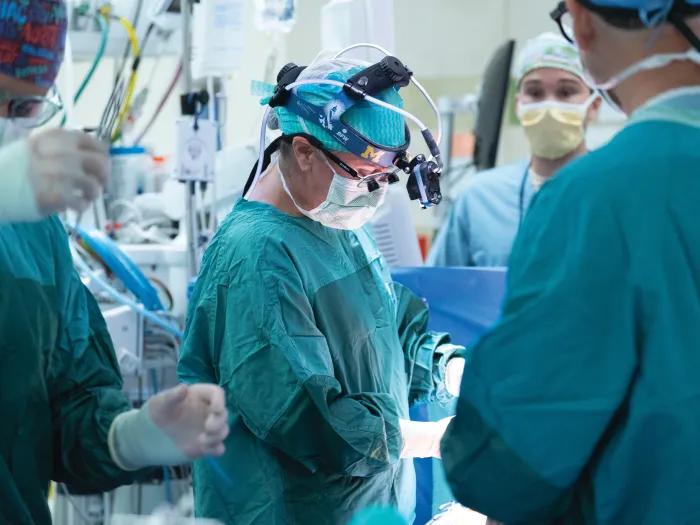
C.S. Mott Children’s Hospital first in country to implant expandable heart valve during FDA review phase
How a temporary heart pump can support high risk cardiac surgery

Treating a rare coronary artery aneurysm without open heart surgery
Fontan patient inspires as pediatric cardiology fellow