
Top of the pageActionset
Psoriasis: Skin, Scalp, and Nail Care
Overview
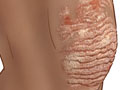
Psoriasis is a long-term (chronic) skin problem that causes skin cells to grow too quickly. This growth causes thick, white, silvery, or red patches of skin (called plaques).
Normally, skin cells grow gradually and flake off about every 4 weeks. New skin cells grow to replace the outer layers of the skin as they shed. But in psoriasis, new skin cells move quickly to the surface of the skin in days rather than weeks. They build up and form thick plaques. The plaques range in size from small to large. They most often appear on the knees, elbows, scalp, hands, feet, or lower back.
Psoriasis is most common in adults. But children and teens can get it too.
How can you protect your skin, scalp, and nails?
Caring for your skin
If you have psoriasis, your skin is very sensitive. Here are some tips you can try to help protect your skin and keep it moist.
- Avoid harsh skin care products that can irritate your skin.
For example, use a mild soap (such as Basis, Dove, or Neutrogena) instead of deodorant soaps or other harsh soaps. Avoid lotions that contain alcohol. They can dry the skin and make psoriasis worse.
- Prevent skin injury.
Don't scratch and pick your skin or cuts and scrapes. An injury to the skin can cause psoriasis patches to form anywhere on the body, including the site of the injury. This includes injuries to your nails or nearby skin while trimming your nails. Tight shoes, clothing, watchbands, and hats can also irritate the skin.
- Be careful in the sun.
Short periods of sun exposure reduce psoriasis in most people. But too much sun exposure can damage the skin and cause skin cancer. Also, sunburns can trigger flares of psoriasis.
- Use moisturizers after bathing.
Some doctors believe that petroleum jelly (such as Vaseline) works well. Solid vegetable oil (such as Crisco) works and is low in cost. Other good moisturizers are Cetaphil, Eucerin, and Lubriderm.
- Take baths or soaks once a day.
This replaces skin moisture that may be lost due to cold, dry climates or to medicines that dry the skin. You will benefit most by applying an ointment, cream, or lotion within 3 minutes after your bath to seal in moisture. Otherwise, when the water evaporates, it will make your skin even drier. Adding bath oils to your bath water can also help, but this can make the tub slippery. If you add oils to your bath water, be very careful.
- Use a home humidifier to increase moisture in the air.
Follow the directions for cleaning the machine.
- Try occlusion therapy.
This therapy involves applying creams or lotions, then wrapping the area with fabric or plastic to keep the skin moist.
- Follow instructions for prescribed medicines.
Caring for your scalp
Here are some tips you can try to help protect your scalp.
- Do not dig, scratch, or pick at your scalp.
- Use a shampoo with salicylic acid, such as Neutrogena T/Sal.
- Shampoo as often as needed to control scaling and allow medicines to reach the scalp.
Work shampoo into a lather and let it stay on for at least 5 to 10 minutes before rinsing it out.
- Follow instructions for prescribed medicines.
Caring for your nails
Here are some tips you can try to protect your nails.
- Soak them before trimming.
- Trim them short and file the edges smooth to avoid injuring them or scratching yourself.
Avoid excessive cleaning under the nail, because it may promote psoriasis scale buildup.
- Do not cut, tear, or bite the skin around your nails (cuticles).
- Use colorless nail polish to protect your nails.
- Wear gloves when working with your hands.
- Follow instructions for prescribed medicines.
Credits
Current as of: November 16, 2023
Author: Healthwise Staff
Clinical Review Board
All Healthwise education is reviewed by a team that includes physicians, nurses, advanced practitioners, registered dieticians, and other healthcare professionals.
Current as of: November 16, 2023
Author: Healthwise Staff
Clinical Review Board
All Healthwise education is reviewed by a team that includes physicians, nurses, advanced practitioners, registered dieticians, and other healthcare professionals.
This information does not replace the advice of a doctor. Healthwise, Incorporated, disclaims any warranty or liability for your use of this information. Your use of this information means that you agree to the Terms of Use. Learn how we develop our content.