Achilles Tendon Problems
Topic Overview
What is the Achilles tendon?
The
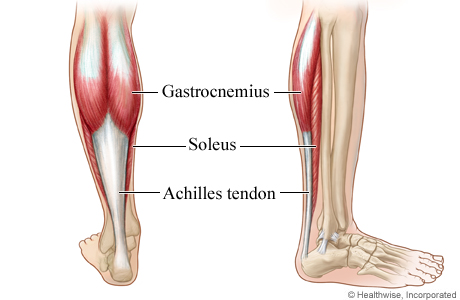
Achilles tendon connects the calf muscle to the heel bone. It lets you rise up on
your toes and push off when you walk or run.
What are common Achilles tendon problems?
The two main problems found in the Achilles tendon are:
- Achilles tendinopathy. Achilles tendinopathy includes one of two conditions:
- Tendinitis. This actually means "inflammation of the tendon," but inflammation is rarely the cause of tendon pain.
- Tendinosis. This refers to tiny tears (microtears) in the tissue in and around the tendon caused by overuse. In most cases Achilles tendon pain is the result of tendinosis, not tendinitis. Some experts now use the term tendinopathy to include both inflammation and microtears. But many doctors may still use the term tendinitis to describe a tendon injury.
- Achilles tendon tear or rupture. An Achilles tendon also can partially tear or completely tear (rupture). A partial tear may cause mild or no symptoms. But a complete rupture causes pain and sudden loss of strength and movement.
Problems with the Achilles tendon may seem to happen suddenly. But usually they are the result of many tiny tears to the tendon that have happened over time.
What causes Achilles tendon problems?
Achilles tendon problems are most often caused by overuse or repeated movements. These movements can happen during sports, work, or other activities. For example, if you do a lot of pushing off or stop-and-go motions when you play sports, you can get microtears in the tendon. Microtears can also happen with a change in how long, hard, or often you exercise. Microtears in the tendon may not be able to heal quickly or completely.
Being out of shape or not warming up before exercising may also cause Achilles tendon problems. So can shoes with poor arch supports or rigid heels.
An Achilles rupture is most often caused by a sudden, forceful motion that stresses the calf muscle. This can happen during an intense athletic activity or even during simple running or jumping. Middle-aged adults are especially likely to get this kind of injury.
A rupture most often occurs in sports such as basketball, racquet sports (including tennis), soccer, and softball. A tendon already weakened by overstretching, inflammation, or small tears is more likely to rupture.
What are the symptoms?
Symptoms of Achilles tendon problems include swelling in the ankle area and mild or severe pain. The pain may come on gradually or may only occur when you walk or run. You may have less strength and range of movement in the ankle.
A rupture of the Achilles tendon may cause a sudden, sharp pain. Most people feel or hear a pop at the same time. Swelling and bruising may occur, and you may not be able to point your foot down or stand on your toes.
How are Achilles tendon problems diagnosed?
Your doctor can tell if you have an Achilles tendon problem by asking questions about your past health and checking the back of your leg for pain and swelling. The doctor may ask: How much pain do you have? How did your injury happen? Have you had other injuries in the ankle area?
If your symptoms are severe or do not improve with treatment, your doctor may want you to get an X-ray, ultrasound scan, or MRI.
How are they treated?
Treatment for mild Achilles tendon problems includes rest, over-the-counter pain medicine, and stretching exercises. You may need to wear well-cushioned shoes and change the way you play sports so that you reduce stress on the tendon. Early treatment works best and can prevent more injury.
Even in mild cases, it can take weeks to months of rest for the tendon to repair itself. It's important to be patient and not return too soon to sports and activities that stress the tendon.
Treatment for severe problems, such as a torn or ruptured tendon, may include surgery or a cast, splint, brace, walking boot, or other device that keeps the lower leg from moving. Exercise, either in physical therapy or in a rehab program, can help the lower leg get strong and flexible again. The tendon will take weeks to months to heal.
Although treatment for Achilles tendon problems takes time, it usually works. Most people can return to sports and other activities.
Frequently Asked Questions
Learning about Achilles tendon problems: |
|
Being diagnosed: | |
Getting treatment: | |
Ongoing concerns: |
Health Tools 
Health Tools help you make wise health decisions or take action to improve your health.
| Decision Points focus on key medical care decisions that are important to many health problems. | |
| Achilles Tendon Rupture: Should I Have Surgery? | |
Cause
Achilles tendinopathy is most often caused by:
- Overuse or repeated movements during sports, work, or other activities. In sports, a change in how long, intensely, or often you exercise, or a change in your environment (such as going from a flat surface to a hill or from a paved road to a dirt road) can cause microtears in the tendon that are unable to heal quickly and will eventually cause pain.
- Injury from repeated push-offs or a stop-and-go motion, common in such activities as running, basketball, tennis, or ballet dancing.
- Poor conditioning or warm-up (as when you start a new activity or have not stretched before and after an activity).
- Shoes with poor arch support or rigid heels that do not cushion the heel.
Achilles tendon rupture is most often caused by:
- Sudden, forceful motion that stresses the calf muscle, such as during an intense athletic activity or even during simple running or jumping, especially in middle-aged adults. A rupture most often occurs in sports such as basketball, racquet sports (including tennis), soccer, and softball.
- Overstretching the tendon during any activity when the tendon is already damaged because of Achilles tendinopathy or another condition.
- Previous corticosteroid injections (in the past, a common treatment for overuse tendon injury). Corticosteroids can weaken or break down tendon tissue, making it more likely to rupture.
Symptoms
Symptoms of Achilles tendinopathy may include:
- Pain in the back of the heel, in the Achilles tendon area. Pain may be mild or severe, and swelling may occur.
- Tenderness in the Achilles tendon area. Tenderness may be more noticeable in the morning.
- Stiffness that goes away as the tendon warms up with use.
- Decreased strength and movement, or a feeling of sluggishness in the leg.
Symptoms of an Achilles tendon rupture may include:
- A sudden, sharp pain that feels like a direct hit to the Achilles tendon. There may be a pop when the rupture occurs. This may be followed by swelling and bruising.
- Heel pain (may be severe).
- Not being able to go on tiptoe with the hurt leg.
If you have a partial rupture (tear) of the Achilles tendon, you may have near-normal strength and less pain after the initial injury, compared to what you experience after a complete rupture.
What Happens
Achilles tendinopathy
Achilles tendinopathy starts with repeated small tears in the tendon, causing no obvious symptoms or mild to severe pain during movement. As the tearing continues, the leg may weaken and the tendon pain may become constant. Abnormal growths (nodules) may develop in the tendon. And it may thicken.
Resting and treating your injured Achilles tendon will likely reduce the pain. Stretching and exercising in physical therapy or a rehabilitation (rehab) program will restore flexibility and strength in your lower leg. Warming up the lower leg and Achilles tendon will help promote healing and keep the condition from getting worse as you resume more intense activities, such as sports or stair climbing.
Without rest and treatment of Achilles tendinopathy, you may develop long-lasting (chronic) pain.
Achilles tendon tear or rupture
An Achilles tendon can partially tear or completely tear (rupture). If your Achilles tendon has ruptured, your leg may be weak, and walking may be difficult.
A tear usually occurs in the tendon about 1.5 in. (3.8 cm) to 2.5 in. (6.4 cm) above its attachment to the heel bone. Some doctors believe that this area is most likely to tear or rupture because of a limited blood supply.
If you treat an Achilles rupture with:
- Surgery followed by a rehab program, you will likely regain full movement and function.
- A cast, brace, splint, walking boot, or other device that keeps your lower leg from moving (immobilization), the tendon will most likely heal but may not be as strong as before the injury and may be more likely to rupture again. Exercising, in physical therapy or in a rehab program, will help restore flexibility and strength in the lower leg.
If you do not treat an Achilles rupture, you will feel weakness in the first steps when walking, with a feeling similar to that of walking in the sand. Eventually, walking will become difficult.
Other Achilles tendon problems
Other conditions can affect the Achilles tendon area alone or along with tendinosis. These other conditions are caused by inflammation and include:
- Achilles paratenonitis, which is an inflammation of the covering of the Achilles tendon. Symptoms include tenderness, pain, and swelling in the Achilles area, all of which are usually worse during activity. This is also called Achilles peritendinitis.
- Retrocalcaneal bursitis, which is an inflammation of the small fluid-filled sac (bursa) between the back of the heel bone and the Achilles tendon, just above the point where the tendon connects to the bone. The inflammation causes swelling, tenderness, and pain on the back of the foot. See an illustration of the retrocalcaneal bursa.
- Insertional Achilles tendinopathy, which is damage in the area where the tendon attaches to the heel bone. Symptoms include tenderness on the lower back of the heel and less ability to overflex the foot. Pain tends to be worst after exercise and can eventually become constant. This condition often develops along with retrocalcaneal bursitis.
What Increases Your Risk
Things that increase your risk for Achilles tendinopathy or rupture include the following.
- Sports and physical activity. Because overuse and repeated movements can cause injury and weaken the Achilles tendon, playing sports increases the risk of an Achilles tendon injury. Activities at work (such as in construction) and at home (such as gardening) may also increase your risk.
- Sports training errors. Not warming up before and after running or other activities or suddenly changing your training program can increase your risk for injury. Increasing your distance, running uphill more often, or changing your ground surfaces (for example, from pavement to sand) too quickly can increase your risk.
- Age. As you age, the blood supply to the Achilles tendon area decreases. Most cases of Achilles tendinopathy or rupture occur in people older than 30.
- Weight. If you are very heavy, you have a greater risk of an Achilles tendon injury.
- Being male. Men are more likely than women to have an Achilles tendon injury.
- High cholesterol. If high cholesterol runs in your family, you have a higher risk of Achilles tendon pain and problems.1
Risk factors for an Achilles tendon rupture include:
- A previous injury to the Achilles tendon.
- A previous rupture of the Achilles tendon.
- Corticosteroid injections in the Achilles tendon, which can weaken the tendon.
- Using quinolone antibiotics, especially if you are older than 60 and/or are taking corticosteroids by mouth.2 Quinolones include ciprofloxacin and ofloxacin.
- Having osteoarthritis, gout, or rheumatoid arthritis.
- Having received dialysis or having had a kidney transplant.2
When To Call a Doctor
Call your doctor immediately if you think you have an Achilles tendon problem (at or above the back of your ankle) and:
- The back of your heel and ankle are very painful.
- You felt a sharp pain like a direct hit to the Achilles tendon.
- You heard a pop in your Achilles tendon when injured.
- You are unable to walk comfortably.
- Your Achilles tendon area has begun to swell.
- You have signs of damage to the nerves or blood vessels, such as numbness, tingling, a pins-and-needles sensation in your foot, or pale or bluish skin.
If you have had an Achilles tendon injury in the past and you have reinjured your Achilles tendon, call your doctor to find out what you need to do. Rest your lower leg and foot until treatment begins.
Watchful Waiting
Watchful waiting is a period of time during which you and your doctor observe your symptoms or condition without using medical treatment. Watchful waiting is not appropriate if you have severe pain in the Achilles tendon area. If you think you have injured your Achilles tendon, call your doctor. Early treatment is most effective in healing the Achilles tendon.
If you think you have Achilles tendinopathy, rest your lower leg and foot for a couple of days and avoid any hard activity. Use ice and pain-relieving medicines to reduce the pain and swelling, and follow the other steps in the Home Treatment section of this topic. If you have weakness, cramping, or constant pain in your Achilles tendon, call your doctor.
Who To See
Health professionals who can diagnosis and treat an Achilles tendon problem include:
- Emergency medical specialists, for sudden and severe (acute) Achilles problems.
- Family medicine physicians or internists who are familiar with foot and ankle injuries.
- Podiatrists who are familiar with sports injuries.
- Sports medicine specialists.
- Orthopedic surgeons, particularly for an Achilles rupture.
You may be referred to a physical therapist for exercises to rebuild your Achilles tendon and leg muscle strength.
To prepare for your appointment, see the topic Making the Most of Your Appointment.
Exams and Tests
Your doctor will usually diagnose an Achilles tendon problem through a medical history and physical exam. During the physical exam, he or she will:
- Check for tenderness. Achilles tendinopathy usually makes the tendon tender to the touch.
- Check your lower leg for gaps in your Achilles tendon, thickening of the tendon, nodules on the tendon, or bony growths on the heel bone.
- Compare your legs to see what is normal motion and how the injury (tendinosis or rupture) has affected the lower leg and ankle. Your doctor will check for changes not only in strength but also in nerve and circulatory symptoms, such as lack of feeling in the area.
To help identify a tear or rupture, your doctor will:
- Squeeze your calves. How your feet move when your calves are squeezed can help diagnose a rupture. A partial tear of the Achilles tendon can be difficult to diagnose when there is minimal pain and near-normal strength after the initial tear. If there is a partial tear, the calf squeeze test may be normal, but a defect may be felt in the tendon.
- Observe how you stand and walk. A sign of a ruptured tendon is not being able to walk on your toes. You may or may not be able to stand and bear weight.
Further tests may be done to clarify a diagnosis or to prepare for surgery. These tests include:
- Magnetic resonance imaging (MRI) to evaluate the tendon for signs of tendinopathy or a tendon rupture and also to evaluate the heel bone. See a picture of an MRI of the Achilles tendon.
- Ultrasound, to evaluate whether there is a rupture of the tendon, or signs of tendinopathy.
- X-rays, to evaluate the heel bone.
Treatment Overview
Treatment for Achilles tendinopathy includes not only rest to allow the tendon to heal but also ways to increase strength and flexibility to prevent further injury. Treatment for an Achilles tendon rupture includes surgery or a cast, splint, brace, walking boot, or other device that will keep your lower leg from moving (immobilization). Early treatment usually results in better healing.
Achilles tendinopathy
To treat Achilles tendinopathy, your doctor will advise you to:
- Rest the lower leg and foot, avoiding any hard or intense activity for 6 to 12 weeks and until symptoms go away.
- Switch or modify sports or other activities that may have caused the tendinopathy.
- Wear well-cushioned shoes, heel pads, or other orthotics if they help relieve pain.
- Reduce pain by using ice or taking over-the-counter pain relievers, such as acetaminophen or nonsteroidal anti-inflammatory drugs (NSAIDs), as directed. An example of acetaminophen is Tylenol. NSAIDS include ibuprofen (Advil, Motrin) and aspirin. Do not give aspirin to anyone younger than 20 because of the risk of Reye syndrome.
- Gently stretch the Achilles tendon area and do general stretches each day and before running or other strenuous activity.
- Follow any physical therapy that your doctor has prescribed, including stretching and strengthening exercises, massage, heat, or ultrasound.
Your doctor may suggest that you wear a night brace to keep your foot flexed, if your Achilles tendon shortens and stiffens while you sleep.
If you continue to have pain or stiffness in the ankle area, your doctor may prescribe a walking boot or other device for 4 to 6 weeks to keep your lower leg and foot from moving and allow the tendon to heal.
If you still have Achilles tendon pain after more than 6 months of consistent treatment and rest, you might need to consider surgery.
Achilles tendon rupture
Treatment for an Achilles tendon rupture includes:
- Surgery followed by rehabilitation (rehab). This is the most common treatment. It reattaches the torn ends of the tendon and can be done through one large incision (open surgery) or several smaller incisions (percutaneous).
- Immobilizing your leg followed by rehab. This prevents movement of the lower leg and ankle and allows the ends of the Achilles tendon to reattach and heal. A cast, splint, brace, walking boot, or other device may be used to do this.
What To Think About
Do not smoke or use other tobacco products. Smoking slows healing because it decreases blood supply and delays tissue repair.
If you have an Achilles tendon rupture, your decision about whether to have surgery will depend in part on your:
- Attitude toward reinjury and complications. Immobilization using a cast or similar device is more likely than surgery to result in another rupture but is less likely to result in complications, such as wound infection.3
- Level of activity. If you are very active in sports or have a job that requires leg strength and you want your leg to be as strong as it was before your injury, you may consider surgery.
- Age. If you are an older adult who does not do activities that may result in another rupture and who does not want the added risk of surgery, you may prefer using a cast or similar device.
- Medical condition. If you have another medical condition—such as diabetes or heart or lung disease—that raises the risks associated with surgery, you may prefer using a cast or similar device.
- Time of injury. Surgery is generally recommended if the rupture is more than 2 weeks old.
Prevention
Most Achilles tendon injuries occur during sports and can be prevented. If you had an Achilles tendon problem in the past, it is especially important to try to prevent another injury by:
- Warming up and stretching. Before any sport or intense activity, gradually warm up your body by doing 5 to 10 minutes of walking or biking and then do stretching exercises. Calf and plantar fascia stretches will stretch the Achilles tendon area. More general stretches target other muscles, such as the hamstrings and groin.
- Cooling down and doing more stretching. After intense activity, gradually cool down with about 5 minutes of easy jogging, walking, or biking, and 5 minutes of stretches.
- Avoiding any sport or intense activity that you are not in condition to do.
- Wearing shoes that cushion your heel during sports or any strenuous activity.
- Wearing heel pads or other orthotics that are designed to reduce stress on the Achilles tendon.
Home Treatment
Home treatment is often used for Achilles tendinopathy and in physical therapy or rehabilitation after an Achilles tendon rupture.
Achilles tendinopathy
If you have Achilles tendinopathy, follow these steps to rest, heal, and strengthen your Achilles tendon and prevent further injury:
- Rest your Achilles tendon. Avoid all activities that strain the tendon, such as stair climbing or running. While allowing your tendon the days, weeks, or months it needs to heal, try other activities, such as swimming. Your doctor will give you information on what you can and cannot do.
- Reduce pain by icing your Achilles tendon and taking nonprescription pain relievers such as acetaminophen or nonsteroidal anti-inflammatory drugs (NSAIDs) as directed. An example of acetaminophen is Tylenol. NSAIDs include ibuprofen (Advil, Motrin) and aspirin. Do not give aspirin to anyone younger than 20 because of the risk of Reye syndrome.
- Follow your physical therapy program if one has been prescribed for you, and do gentle stretching and strengthening exercises, especially focusing on calf stretches.
- Do not smoke or use other tobacco products. Smoking slows healing, because it decreases blood supply and delays tissue repair.
- Wear footwear that protects the tendon while it is healing.
- Quality athletic shoes that support your arches and cushion your heels can make a big difference in your daily comfort and the healing process. If needed, talk to your physical therapist or podiatrist about heel pads or orthotics.
- A bandage that keeps your foot flexed can restrict the motion of the Achilles tendon.
- A silicone sleeve or pad can distribute pressure on the Achilles tendon.
Your doctor may suggest you wear a night brace to keep your foot flexed, if your Achilles tendon shortens and stiffens while you sleep.
Achilles tendon rupture
Whether you treat an Achilles tendon rupture with surgery or use a cast, splint, brace, walking boot, or other device to keep your lower leg from moving (immobilizing your leg), after treatment it's important to follow the rehabilitation program prescribed by your doctor and physical therapist. This program helps your tendon heal and prevents further injury.
Medications
You can use medicine to relieve pain from Achilles tendinopathy or an Achilles tendon rupture. The medicine may be prescription or nonprescription.
- Acetaminophen can relieve pain. One example is Tylenol.
- Nonsteroidal anti-inflammatory drugs (NSAIDs) are also often used to treat pain from Achilles tendinopathy or rupture. But because most tendon problems do not involve inflammation, NSAIDs are not usually needed. NSAIDS include ibuprofen (Advil, Motrin) and aspirin. Do not give aspirin to anyone younger than 20 because of the risk of Reye syndrome.
- Corticosteroid injections, which sometimes are injected around tendons or into joints to reduce pain and inflammation, are not used to treat Achilles tendinopathy, because they may increase the risk of a tendon rupture.
Surgery
Achilles tendinopathy
Surgery usually is not needed to treat Achilles tendinopathy. But in rare cases, someone might consider surgery when rubbing between the tendon and the tissue covering the tendon (tendon sheath) causes the sheath to become thick and fibrous. Surgery can be done to remove the fibrous tissue and repair any small tendon tears. This may also help prevent an Achilles tendon rupture.
Achilles tendon rupture
Surgery is often used to reattach the ends of a ruptured Achilles tendon. It provides a better chance of preventing the tendon from rupturing again compared to using a cast, splint, brace, walking boot, or other device that will keep your lower leg from moving (immobilization).3
The results of surgery for an Achilles tendon rupture are best when you have the surgery soon after your injury. Recovering from surgery may take months, and it requires a rehabilitation (rehab) program to help heal and strengthen the tendon.
Surgery Choices
Surgery for an Achilles tendon rupture can be open or percutaneous.
- In open surgery, the surgeon makes a single large incision in the back of the leg and stitches the torn tendon back together.
- In percutaneous surgery, the surgeon makes several small incisions (rather than one large incision) and stitches the torn tendon back together.
What To Think About
The differences in age and activity levels of participants can make it difficult to determine if Achilles tendon surgery is effective. The success of your surgery can depend on your surgeon's experience, the type of surgical procedure used, the extent of tendon damage, how soon after rupture the surgery is done, how soon your rehab program starts after surgery, and how well you follow your rehab program.
Talk to your surgeon about his or her surgical experience and success rate with the technique that would best treat your condition.
Other Treatment
Other treatments are often used for Achilles tendinopathy and rupture. Before using other treatments, you most likely will try rest and medicine to reduce pain and swelling.
Achilles tendinopathy
Common physical therapy treatments for Achilles tendinopathy include:
- Stretching and flexibility exercises to help your tendon heal without shortening and becoming chronically painful.
- Ultrasound heat therapy to improve blood circulation, which may aid the healing process.
- Massage, to help increase flexibility and blood circulation in the lower leg and to help prevent further injury.
- Wearing a night brace to keep your leg flexed and prevent your Achilles tendon from tightening while you sleep. An Achilles tendon that often tightens at night is not able to heal properly.
If other treatment does not reduce your Achilles tendinopathy pain, your doctor may recommend using a cast, brace, walking boot, splint, or other device for 4 to 6 weeks to prevent your lower leg and foot from moving and to allow the tendon to heal. This is then followed by physical therapy and modification of activities.
Achilles tendon rupture
A cast or similar device can be used to immobilize a ruptured Achilles tendon, giving it time to heal on its own. A cast or similar device prevents the lower leg and ankle from moving. Treatment with this type of device may take as long as 6 months to completely heal a tendon. This is usually followed by a rehabilitation (rehab) program that helps you regain strength and flexibility in the tendon and leg. The rehab program may include physical therapy as noted above.
Other Places To Get Help
Organizations
| American Academy of Orthopaedic Surgeons (AAOS) | |
| 6300 North River Road | |
| Rosemont, IL 60018-4262 | |
| Phone: | 1-800-346-AAOS (1-800-346-2267) (847) 823-7186 |
| Fax: | (847) 823-8125 |
| Email: | orthoinfo@aaos.org |
| Web Address: | www.orthoinfo.aaos.org |
The American Academy of Orthopaedic Surgeons (AAOS) provides information and education to raise the public's awareness of musculoskeletal conditions, with an emphasis on preventive measures. The AAOS website contains information on orthopedic conditions and treatments, injury prevention, and wellness and exercise. | |
| American College of Foot and Ankle Surgeons (ACFAS) | |
| 8725 West Higgins Road | |
| Suite 555 | |
| Chicago, IL 60631-2724 | |
| Phone: | 1-800-421-2237 (773) 693-9300 |
| Fax: | (773) 693-9304 |
| Email: | info@acfas.org |
| Web Address: | www.foothealthfacts.org |
The American College of Foot and Ankle Surgeons provides information on surgery and shoe selection as well as the care and treatment of heel, toe, ankle, nerve, tendon, nail, and skin conditions; sports injuries; diabetic foot problems; arthritis; and resources in your local area. Some information is available in Spanish. | |
| American Podiatric Medical Association | |
| 9312 Old Georgetown Road | |
| Bethesda, MD 20814-1621 | |
| Phone: | 1-800-FOOTCARE (1-800-366-8227) (301) 581-9200 |
| Fax: | (301) 530-2752 |
| Email: | info@apma.org |
| Web Address: | www.apma.org |
The American Podiatric Medical Association (APMA) provides information about foot and ankle injuries, sports-related foot concerns, surgical and nonsurgical treatment of foot problems, special medical issues such as diabetes, and resources in your local area. Some information is available in Spanish. | |
| National Institute of Arthritis and Musculoskeletal and Skin Diseases (NIAMS), National Institutes of Health | |
| 1 AMS Circle | |
| Bethesda, MD 20892-3675 | |
| Phone: | 1-877-22-NIAMS (1-877-226-4267) toll-free |
| Phone: | (301) 495-4484 |
| Fax: | (301) 718-6366 |
| TDD: | (301) 565-2966 |
| Email: | niamsinfo@mail.nih.gov |
| Web Address: | www.niams.nih.gov |
The National Institute of Arthritis and Musculoskeletal and Skin Diseases (NIAMS) is a governmental institute that serves the public and health professionals by providing information, locating other information sources, and participating in a national federal database of health information. NIAMS supports research into the causes, treatment, and prevention of arthritis and musculoskeletal and skin diseases and supports the training of scientists to carry out this research. The NIAMS website provides health information referrals to the NIAMS Clearinghouse, which has information packages about diseases. | |
Related Information
References
Citations
- Beeharry D, et al. (2005). Familial hypercholesterolaemia commonly presents with Achilles tenosynovitis. Annals of Rheumatic Disease, 65: 312–315.
- Van der Linden PD, et al. (2003). Increased risk of Achilles tendon rupture with quinolone antibacterial use, especially in elderly patients taking oral corticosteroids. Archives of Internal Medicine, 163(15): 1801–1807.
- Khan RJ, et al. (2010). Surgical interventions for treating acute Achilles tendon ruptures. Cochrane Database of Systematic Reviews (9).
Other Works Consulted
- American Academy of Orthopaedic Surgeons (2009). Diagnosis and Treatment of Acute Achilles Tendon Rupture: Guideline and Evidence Report. Available online: http://www.aaos.org/Research/guidelines/atrguideline.pdf.
- Maffulli N, Ajis A (2008). Management of chronic ruptures of the Achilles tendon. Journal of Bone and Joint Surgery, 90(6): 1348–1360.
- Reddy SS, et al. (2009). Surgical treatment for chronic disease and disorders of the Achilles tendon. Journal of the American Academy of Orthopaedic Surgeons, 17(1): 3–14.
- Srinivasan RC, et al. (2010). Injuries of the ankle region section of Orthopedic surgery. In Current Diagnosis and Treatment: Surgery, 13th ed., pp. 1044–1048. New York: McGraw-Hill.
- Stretanski MF (2008). Achilles tendinitis. In WR Frontera et al., eds., Essentials of Physical Medicine and Rehabilitation, 2nd ed., pp. 407–410. Philadelphia: Saunders Elsevier.
Credits
| By | Healthwise Staff |
|---|---|
| Primary Medical Reviewer | Anne C. Poinier, MD - Internal Medicine |
| Specialist Medical Reviewer | David Bardana, MD, FRCSC - Orthopedic Surgery, Sports Medicine |
| Last Revised | January 3, 2011 |
- Top of Page
-
Next Section:
Health Tools
-
Previous Section:
Topic Overview - Top of Page
-
Next Section:
Cause
-
Previous Section:
Health Tools - Top of Page
-
Next Section:
Symptoms
-
Previous Section:
Cause - Top of Page
-
Next Section:
What Happens
-
Previous Section:
Symptoms - Top of Page
-
Next Section:
What Increases Your Risk
-
Previous Section:
What Happens - Top of Page
-
Next Section:
When To Call a Doctor
-
Previous Section:
What Increases Your Risk - Top of Page
-
Next Section:
Exams and Tests
-
Previous Section:
When To Call a Doctor - Top of Page
-
Next Section:
Treatment Overview
-
Previous Section:
Exams and Tests - Top of Page
-
Next Section:
Prevention
-
Previous Section:
Treatment Overview - Top of Page
-
Next Section:
Home Treatment
-
Previous Section:
Prevention - Top of Page
-
Next Section:
Medications
-
Previous Section:
Home Treatment - Top of Page
-
Next Section:
Surgery
-
Previous Section:
Medications - Top of Page
-
Next Section:
Other Treatment
-
Previous Section:
Surgery - Top of Page
-
Next Section:
Other Places To Get Help
-
Previous Section:
Other Treatment - Top of Page
-
Next Section:
Related Information
-
Previous Section:
Other Places To Get Help - Top of Page
-
Next Section:
References
-
Previous Section:
Related Information - Top of Page
-
Next Section:
Credits
-
Previous Section:
References - Top of Page
Last Revised: January 3, 2011
This information does not replace the advice of a doctor. Healthwise, Incorporated disclaims any warranty or liability for your use of this information. Your use of this information means that you agree to the Terms of Use. How this information was developed to help you make better health decisions.
To learn more visit Healthwise.org
© 1995-2012 Healthwise, Incorporated. Healthwise, Healthwise for every health decision, and the Healthwise logo are trademarks of Healthwise, Incorporated.